
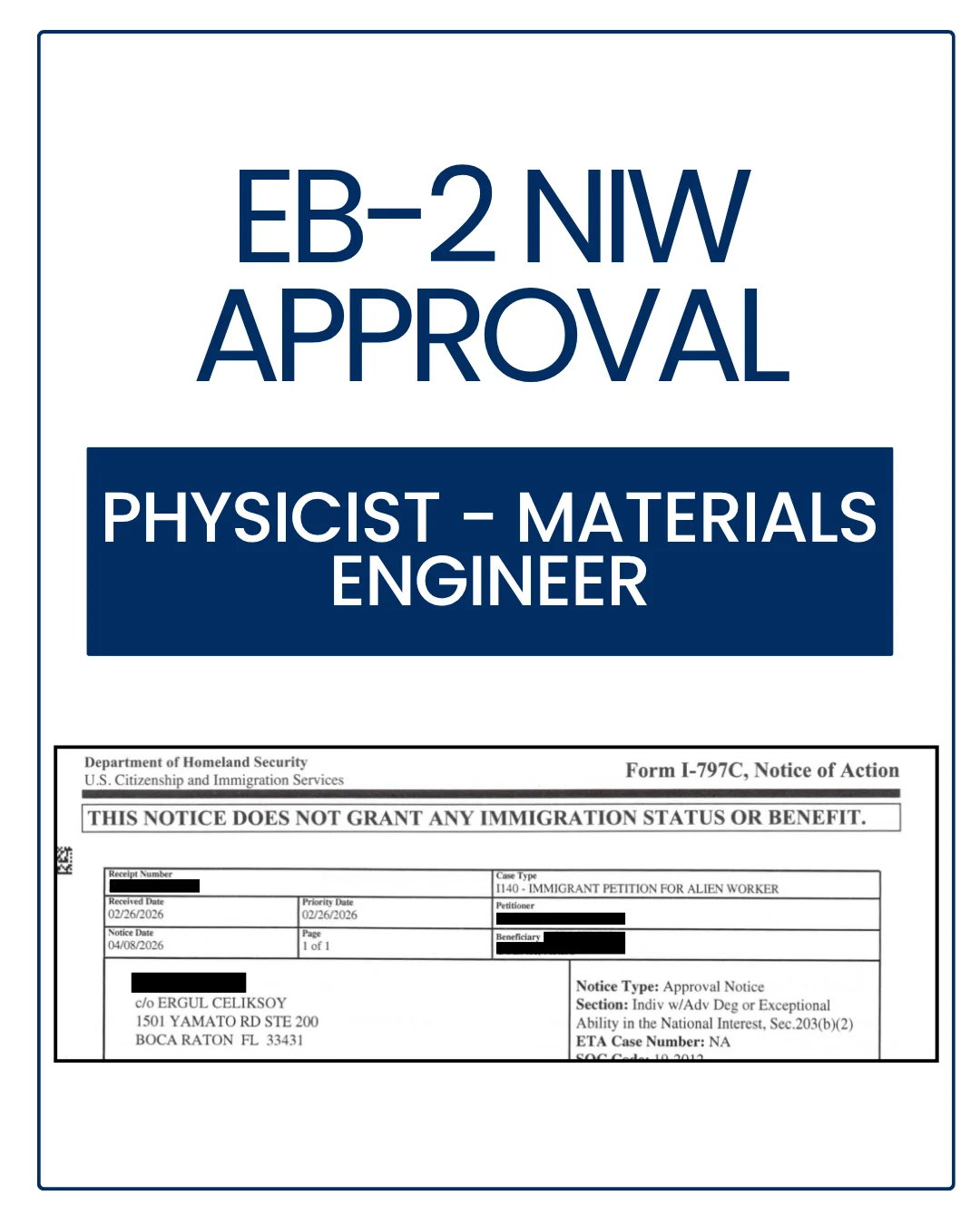
Celiksoy Law secured EB-2 National Interest Waiver approval for a physicist and materials scientist whose work connects nanoscale surface measurements with practical engineering questions. Her petition brought together research on adhesion, friction, and mechanical behavior, experience in semiconductor equipment engineering, and a proposed U.S. endeavor spanning manufacturing reliability, low-friction materials, and biological interfaces.
The common thread was measurement: making small-scale interactions observable and interpretable so that researchers and engineers can investigate how materials perform. We presented that capability through specific publications, professional responsibilities, and the methods she proposed to develop further.
Surface science with an engineering purpose
Our client’s education included undergraduate, master’s, and doctoral study in physics. Her early work involved experimental spectroscopy and materials characterization. Her doctoral research subsequently focused on adhesion between surfaces, using atomic force microscopy to investigate the influence of roughness, humidity, and contact geometry.
Atomic force microscopy, or AFM, uses a small probe to examine surfaces and measure their interactions. In this case, the technique provided a shared experimental foundation across different materials and applications. Nanotribology—the study of friction and related surface behavior at very small scales—was another central area of expertise.
Her research career included international postdoctoral appointments, work on mechanical properties and biological interfaces, and a university faculty role involving independent research, teaching, and student supervision. She later moved into a senior materials engineering position with a semiconductor equipment manufacturer.
The petition described industry responsibilities involving surface measurement, friction testing, nanoindentation, data analysis, and collaboration with engineering and manufacturing teams. These responsibilities connected her experimental physics background to materials challenges affecting precision equipment.
Three connected objectives for the proposed U.S. work
More reproducible measurements for semiconductor manufacturing. The client proposed developing AFM-based methods to quantify adhesion, friction, roughness, and mechanical response in manufacturing systems. The plan included measurement protocols, analysis frameworks, and diagnostic metrics relevant to lithography and wafer handling. The objective was to help identify surface-related failure mechanisms and inform improvements in equipment reliability and process stability.
Investigating exceptionally low-friction materials. A second objective concerned solid-state superlubricity: a regime of extremely low friction under particular conditions. She planned to investigate two-dimensional materials, including MXenes, and evaluate the relationship between structure, environmental exposure, friction, and wear. Potential applications included systems where liquid lubrication is difficult or impractical, with further testing needed to establish suitability for specific operating conditions.
Measuring forces at biological interfaces. The third objective used force spectroscopy and nanomechanical testing to investigate molecular interactions at interfaces between cells and materials. This work aimed to provide mechanistic information relevant to biomaterials and bio-integrated systems.
The applications differed, but the research approach remained connected: measure surface interactions, establish relationships between material properties and behavior, and evaluate their relevance to a defined engineering or scientific problem. The petition argued that such methods could contribute beyond an individual research project or position through their use across materials and measurement settings.
Publications made the technical contribution concrete
Adhesion, roughness, and humidity. A first-author study measured adhesion between flat probes and silicon surfaces under different humidity conditions. It showed that surface roughness and environmental conditions materially affected the measured forces. This supported the client’s experience investigating factors that must be understood when interpreting surface measurements.
The reliability of measurement procedures. Another first-author study examined how instrumental settings influence adhesion measurements in a flat-contact geometry. Its role in the petition was methodological: reliable comparisons depend on understanding the measurement procedure as well as the material being tested.
Low-friction two-dimensional materials. A coauthored study investigated nanoscale friction in layered MXene samples, including how layer configuration and environmental exposure affected performance. The reported experimental stability supported further investigation of solid lubrication. We connected this research to her proposed materials work while retaining the distinction between laboratory measurements and qualification for an industrial system.
Mechanical behavior at biological interfaces. A first-author hydrogel study used single-molecule force measurements to investigate cross-links associated with cell attachment. A separate coauthored study investigated light-driven molecular motors for applying forces to cellular receptors. These publications supported the bio-interface dimension of the proposed endeavor and demonstrated the use of nanoscale mechanical methods in interdisciplinary research.
Surface chemistry and material stiffness. A first-author study of self-assembled nanocrystals investigated relationships between coating chemistry, structure, and mechanical response. This provided another example of connecting nanoscale features with measured material properties.
Together, the publications demonstrated different uses of a related experimental skill set. First-author studies supported specific research contributions, while collaborative studies showed how her expertise could be integrated with other disciplines.
An industrial contribution alongside the academic record
The support letter also described an invention disclosure and a subsequent defensive publication concerning a surface-wear problem in semiconductor lithography equipment. This provided an example of applying surface mechanics expertise to an engineering challenge in a commercial setting.
We treated this record separately from the peer-reviewed publications. Its role was to document the industrial contribution described in the petition; a defensive publication is distinct from a granted patent. The engineering proposal also remained separate from claims of demonstrated deployment, quantified production gains, or independently verified cost savings.
The broader industry experience strengthened the connection between the proposed measurement methods and process-relevant problems. Her role involved interpreting material behavior and preparing technical documentation with cross-functional teams, complementing her academic research and teaching background.
Funded research and scientific evaluation
The petition described participation as a funded researcher in an international surface physics research and training program. Fellowship, contractual, and supervision records were presented to explain her research responsibilities and structured training. This supported her development within a collaborative research environment.
Conference records described oral presentations, invited talks, and posters. Her professional service included journal peer review, evaluation of research and scholarship applications, conference abstract review, and graduate examination committees. These activities supported experience communicating research and assessing scientific work in different settings.
An independent expert opinion and a collaborator’s reference explained the relevance of her measurement methods, materials research, and professional experience. We distinguished their relationships to the client and considered their assessments alongside the underlying record.
The evidence and its role in the petition
| Evidence described in the petition | Role in the presentation |
|---|---|
| Physics degrees, credential evaluation, and thesis records | Established advanced education and the experimental basis of her specialization. |
| Research and faculty appointment records | Documented research experience, teaching, supervision, and interdisciplinary work. |
| Semiconductor engineering employment records | Connected surface characterization expertise with precision equipment challenges. |
| First-author adhesion and measurement studies | Supported experience investigating environmental and instrumental influences on surface measurements. |
| Coauthored low-friction materials study | Connected nanoscale friction research with the proposed solid-lubrication work. |
| Hydrogel and molecular-force publications | Supported the proposed investigation of mechanical interactions at biological interfaces. |
| Nanocrystal mechanics publication | Demonstrated investigation of surface chemistry, structure, and mechanical response. |
| Industrial invention disclosure and publication notification | Supported the engineering contribution described in the letter, considered separately from patents and academic articles. |
| Citation records | Supplied scholarly context, subject to accurate matching of the cited and citing works. |
| Research funding, contract, and supervision records | Explained her funded research role and responsibilities within a collaborative program. |
| Conference and scientific evaluation records | Supported dissemination and experience assessing research, applications, and graduate work. |
| Independent expert opinion and collaborator reference | Explained scientific relevance from distinct professional perspectives. |
| Proposed endeavor statement | Connected established methods with defined future research and engineering objectives. |
Connecting measurement expertise to the NIW argument
We organized the case around the relationship between the client’s methods, research record, and proposed applications. The national-interest argument addressed the potential value of more reliable surface measurements and materials research across semiconductor manufacturing and other engineering settings. Her academic and industrial experience supported her preparedness to pursue the proposed activities.
The waiver argument focused on the broader contribution of this specialized expertise through research, applied engineering, and scientific dissemination. USCIS approved the EB-2 NIW petition; the notice confirms the outcome without providing detailed findings on individual evidence items.
At Celiksoy Immigration Lawyers, we assess scientists’ and engineers’ research contributions, proposed U.S. work, and supporting records together. To discuss an EB-2 NIW petition, contact us at us@celiksoylaw.com. Each case is assessed on its own facts and evidence.