
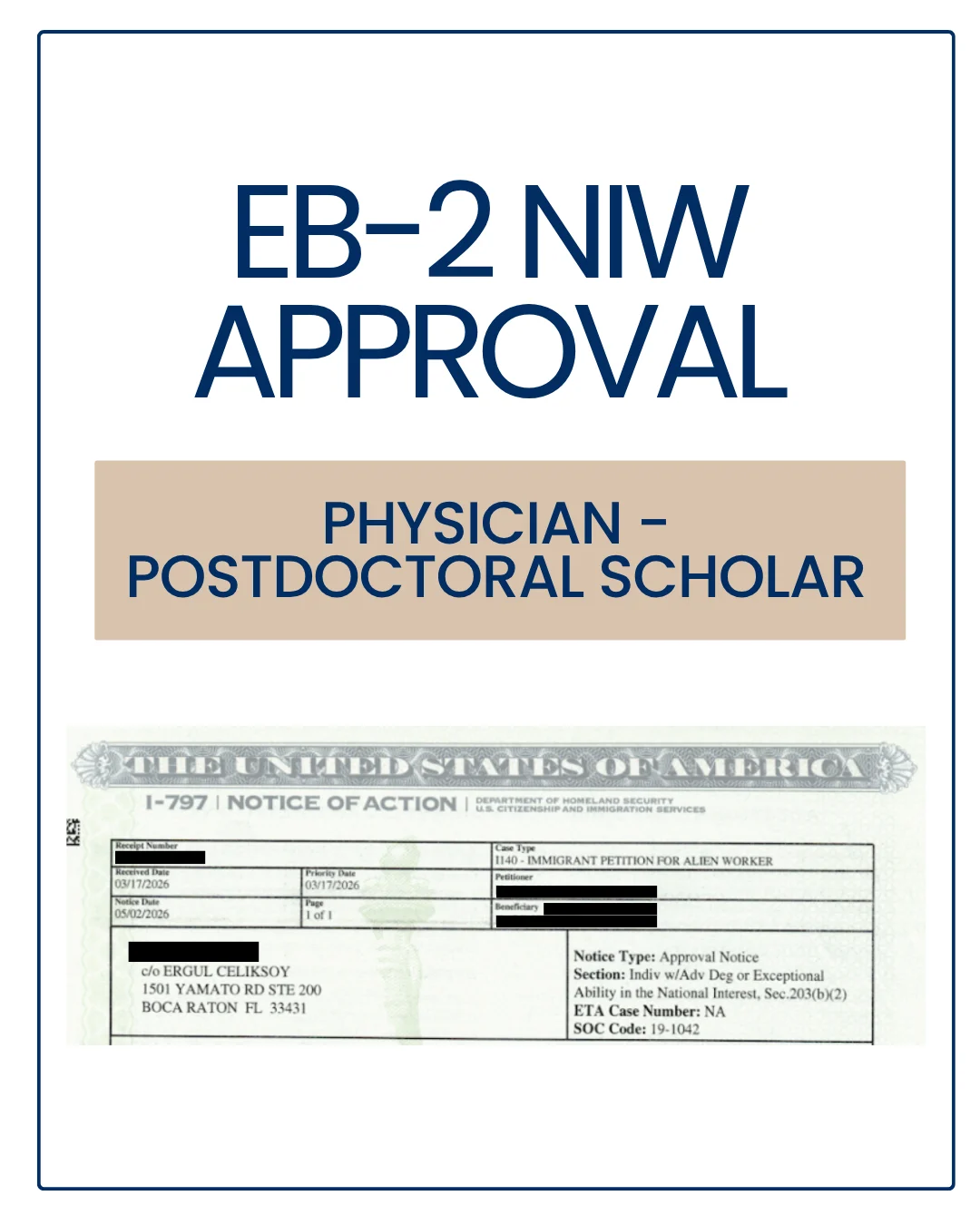
Celiksoy Law secured EB-2 National Interest Waiver approval for a physician and postdoctoral researcher whose work focuses on surgical outcomes and patient safety. His petition connected medical education, supervised clinical experience, surgical publications, and a U.S. research appointment with a proposed endeavor addressing neurosurgical risk assessment, minimally invasive endocrine procedures, and the evaluation of AI-assisted decision-support tools.
The case centered on a practical research question: how can information collected before, during, and after surgery help researchers identify risks and evaluate care? We presented his record through the methods he had used and the collaborative studies he proposed to pursue.
Medical experience with a defined research direction
Our client completed medical school and gained supervised experience across surgery, emergency medicine, critical care, and other hospital services. Surgical electives introduced him to complex neurosurgical conditions and endocrine procedures. Subsequent residency experience in otolaryngology and family medicine broadened his understanding of head and neck anatomy, perioperative care, and patient needs across different settings.
He later joined a U.S. academic neurosurgery department as a postdoctoral scholar. The petition described a research-focused role within multidisciplinary teams, working on cerebrovascular and skull base conditions, outcomes analysis, and perioperative questions.
This appointment provided a concrete setting for the proposed work. His role concerned research analysis and protocol development in collaboration with faculty surgeons, with the medical background helping him interpret clinically relevant questions.
The proposed U.S. endeavor
Investigating risk and recovery in complex neurosurgical disease. The client proposed retrospective and prospective cohort studies examining clinical variables, imaging findings, operative information, and postoperative follow-up. The objective was to identify factors associated with complications and neurological or functional recovery, and to generate evidence relevant to risk assessment and care pathways.
Evaluating minimally invasive endocrine procedures. A second workstream focused on transoral thyroid and parathyroid surgery, performed through an approach inside the mouth. The plan included multicenter outcomes research, patient selection, complication assessment, functional outcomes, and quality-of-life measures. Comparative studies and standardized evaluation were proposed to investigate where these techniques could be used safely and appropriately.
Assessing AI-assisted information and decision support. The third workstream involved evaluating the reliability and limitations of tools used for evidence synthesis, risk assessment, and surgical planning. Validation, transparency, and physician oversight were part of the proposed approach. The objective was to investigate useful support for clinical teams, rather than assume that an AI tool had already improved patient outcomes.
The petition argued that this research could have relevance beyond a single appointment through shared findings, reproducible methods, and evidence that other surgical teams could evaluate. Reductions in complications, recovery time, and healthcare costs were intended benefits to be investigated through the proposed work.
Publications supported the research methods
Neurosurgical care during the pandemic. A first-author retrospective study compared a hospital’s neurosurgical activity before and during the COVID-19 pandemic. It reported reduced surgical volume and increased overall mortality in the pandemic period. This supported experience working with clinical records and interpreting outcomes in the context of changes in service delivery. The observational comparison did not establish a single cause for those differences.
Complications and conversion in transoral thyroid surgery. A shared-first-author multicenter study examined patients who underwent a transoral approach, comparing those with and without complications or conversion to open surgery. It used propensity score matching to address measured differences between the groups. Associations found before matching were no longer statistically significant afterward. The publication supported methodological experience in outcomes analysis and careful interpretation of risk-factor findings.
Testing technical limits before clinical use. A first-author cadaver study evaluated a single-port transoral technique and identified anatomical and technical safety concerns. This was a valuable part of the record because the research identified limitations requiring further improvement. It supported experience assessing surgical feasibility without presenting the tested approach as ready for clinical adoption.
Collaborative clinical evidence. A coauthored multicenter report described early transoral thyroid and parathyroid surgery outcomes in experienced surgical centers. It supported engagement with collaborative datasets and the evaluation of complications and procedural characteristics.
Evaluating clinical information tools. A first-author study compared an earlier chatbot version with an established evidence-based clinical reference using ENT case scenarios. Reviewers assessed usefulness and reference accuracy, finding stronger performance from the reference platform in the tested setting. This provided a concrete foundation for the proposed emphasis on evaluating AI reliability. The study assessed responses to scenarios, rather than outcomes from treating patients with an AI system.
Evidence synthesis in neuro-oncology. A review of glioblastoma research models examined their strengths, limitations, and translational relevance. Its role was to demonstrate evaluation and synthesis of existing research, complementing the original clinical and technical studies.
Research training and professional engagement
The support letter described supervised research education projects involving cadaveric feasibility, retrospective cohort analysis, and prospective assessment of postoperative voice quality. These activities helped explain how the client developed experience with different study designs and patient-centered outcome measures.
Conference records documented presentations and scientific engagement. Journal peer-review records supported experience assessing other researchers’ work, while professional membership supplied context for participation in neuroscience networks.
The petition also described a medical education scholarship, examination records, research electives, observational experiences, and institutional training. Recommendations and a research elective evaluation documented professional assessments arising from those experiences. These records complemented the publication and appointment evidence.
The evidence and its role in the petition
| Evidence described in the petition | Role in the presentation |
|---|---|
| Medical diploma and diploma supplement | Established the educational foundation presented for the EB-2 advanced-degree requirement. |
| Clinical training and residency history | Explained supervised experience with surgical care, critical care, and patient management. |
| U.S. postdoctoral appointment documentation | Identified the collaborative research setting for the proposed endeavor. |
| Retrospective neurosurgical outcomes publication | Supported experience analyzing hospital activity and clinical outcomes. |
| Shared-first-author matched cohort study | Demonstrated experience evaluating complications and interpreting adjusted analyses. |
| First-author cadaver feasibility study | Supported anatomical and technical assessment before clinical implementation. |
| Collaborative transoral surgery publication | Documented participation in multicenter outcomes research. |
| Clinical information tool comparison | Connected prior evaluation work with the proposed focus on AI reliability and evidence quality. |
| Glioblastoma review | Demonstrated synthesis of existing translational research. |
| Citation and conference records | Provided scholarly context and evidence of dissemination. |
| Supervised research education certificates | Supported methodological training across several study designs. |
| Peer-review and membership records | Documented scientific evaluation experience and professional participation. |
| Scholarship, examination, elective, and training records | Explained educational support and continued professional development. |
| Recommendations and elective evaluation | Supplied assessments grounded in observed academic and research engagement. |
| Proposed endeavor statement | Linked prior methods and experience with defined future research objectives. |
Presenting a coherent surgical research case
We organized the petition around patient safety and outcomes evaluation. The publications addressed different settings, but they shared a concern with evidence quality: interpreting clinical data, assessing a technique’s limitations, and evaluating information used in medical decisions.
The proposed endeavor gave that record a defined direction. The research appointment supported a setting for implementation, while publications and structured training supplied evidence of preparedness. The waiver argument addressed the potential wider contribution of collaborative findings and research methods across institutions.
USCIS approved the EB-2 NIW petition. The approval notice confirms the outcome without providing detailed findings on individual evidence items.
At Celiksoy Immigration Lawyers, we assess physicians’ research records, proposed U.S. endeavors, and supporting documentation together. To discuss an EB-2 NIW petition, contact us at us@celiksoylaw.com. Each case is assessed on its own facts and evidence.