
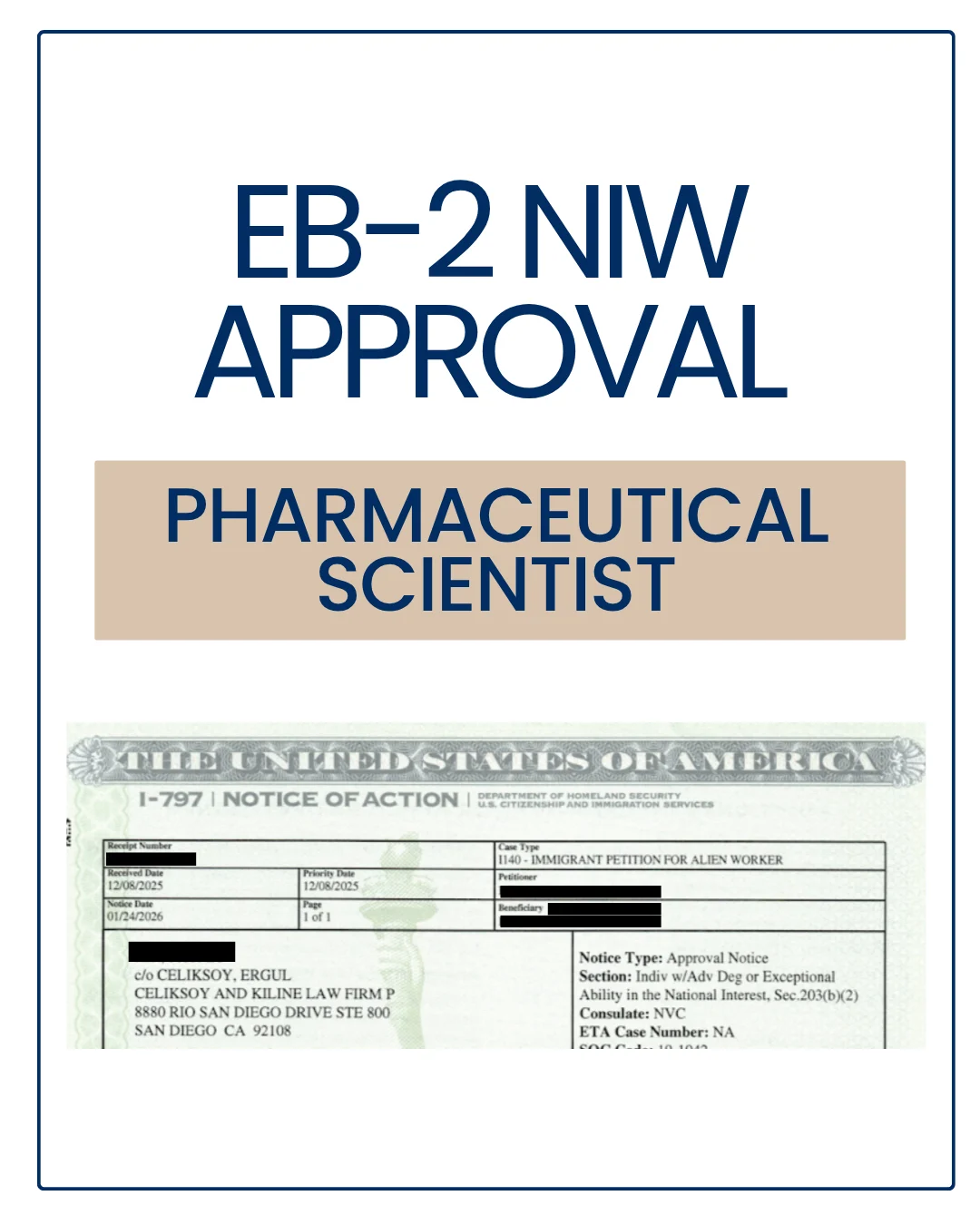
Celiksoy Law secured EB-2 National Interest Waiver approval for a pharmaceutical scientist specializing in pharmacometrics: the use of quantitative models to investigate drug exposure and response. Her petition connected experimental research on drug absorption with computational modeling and pharmaceutical industry experience, supporting a proposed U.S. endeavor focused on more informative dosing and drug development analyses.
The central question behind her work was practical: how can disease, nutritional status, and individual variability change what happens to a medication in the body? We presented her experience investigating that question alongside a plan to apply those methods to clinical study data, dose selection, and regulatory submission analyses.
A research background connecting measurement and modeling
Our client held a Ph.D. in Biopharmaceutics and Pharmacokinetics, following undergraduate education in pharmaceutical sciences. Her doctoral research examined the effects of undernutrition on drug absorption and intestinal permeability, using experimental systems and mathematical analysis.
Her background included intestinal cell models, animal research, and methods for measuring drug concentrations. This combination supported a research approach that connects the collection of reliable measurements with models designed to explain drug behavior.
International research experience added further dimensions. In a research placement, she worked on population pharmacokinetics and limited sampling strategies, including questions involving pediatric and neonatal patients. The objective was to characterize drug exposure with fewer blood samples. A subsequent visiting research appointment focused on pharmacometric modeling in the context of undernutrition.
Her record also included university teaching and a remote postdoctoral pharmacometrician role with a U.S.-based pharmaceutical research company. The petition described work on preclinical and clinical datasets, from assembling and cleaning data to developing population models and preparing analytical documentation for new drug application submissions, particularly in oncology.
The proposed U.S. endeavor
The proposed endeavor brought together several related activities.
Investigating disease and nutritional effects on drug exposure. The client planned to examine how undernutrition, obesity, cancer, and other complex conditions affect absorption, distribution, metabolism, and excretion. These are the processes that determine how a drug moves through and leaves the body. Her objective was to quantify relevant changes and investigate their implications for dosing.
Developing complementary pharmacokinetic models. Physiologically based models would connect drug behavior with biological processes. Population models would investigate variability and factors associated with differences between patients. These approaches would support analyses of groups whose drug exposure may be difficult to characterize through average results alone.
Supporting clinical development decisions. She proposed using clinical study data to build and evaluate models, followed by simulations to inform dose selection, dose–response assessment, and trial design. The plan included analyses relevant to narrow therapeutic index drugs, where the margin between effective and harmful exposure can be small.
Preparing and sharing quantitative findings. Pharmacometric reports would contribute to regulatory submission packages. Publications and conference presentations would make specialized findings available for further research and consideration in dosing guidance. These were objectives of the proposed work, with their eventual impact dependent on the evidence generated and evaluated.
The petition argued that this endeavor had potential relevance beyond a single position: models, methods, and disseminated analyses could contribute to decisions across research and drug development settings.
Publications supported distinct parts of the plan
The publication record provided concrete examples of the client’s scientific methods.
Undernutrition and drug absorption. A first-author animal study combined drug concentration measurements with minimal physiologically based pharmacokinetic modeling. It identified increased exposure and modeled bioavailability for the study drugs in undernourished rats. The work supported experience investigating altered absorption in a preclinical setting, providing a foundation for further research rather than established dosing recommendations for patients.
Reliable analytical measurements. Research on chromatographic methods addressed the simultaneous measurement of drug compounds and a marker used in intestinal perfusion studies. First-author and coauthored publications supported experience developing and validating methods needed to investigate absorption and permeability. Their role in the petition was to establish the measurement expertise underlying her modeling work.
Formulation behavior. A first-author laboratory study compared the dissolution of intact and crushed modified-release tablets. Crushing changed the release profiles under the tested conditions. This supported experience relating formulation changes to potential exposure questions; the study evaluated laboratory dissolution, rather than patient outcomes.
Variability in bioequivalence. A coauthored simulation study examined how within-subject variability influences individual exposure ratios when comparing formulations. It connected her modeling experience to questions about interchangeability and the interpretation of average bioequivalence results. This provided a relevant foundation for the proposed focus on exposure variability and drugs requiring particularly careful dose assessment.
The petition also described acceptance of a cross-species pharmacokinetic modeling manuscript. Its integration of published data and physiological modeling added evidence of an ongoing research trajectory. We distinguished the client’s authorship roles and the methods used across the record, rather than presenting every publication as the same type of contribution.
Research support and professional engagement
The support letter described doctoral scholarship funding, an international research fellowship, mobility support, and participation in a university-funded thesis project. These records helped explain the support available for her training and research, with personal fellowships distinguished from project funding in which she participated.
Scientific presentations documented dissemination of experimental and modeling work. Journal peer-review records supported experience evaluating other researchers’ methods and findings. Specialized training in pharmacokinetic–pharmacodynamic modeling, population analysis, and simulation software complemented her research experience.
Reference and independent expert letters supplied professional assessments of the connection between her prior work and proposed endeavor. We presented these assessments alongside the underlying record of research, training, and industry work.
The evidence and its role in the petition
| Evidence described in the petition | Role in the presentation |
|---|---|
| Degrees, transcripts, and doctoral thesis records | Established advanced education and the absorption research underlying her specialization. |
| Research appointment and university teaching records | Documented experience in pharmacokinetics, modeling, research collaboration, and scientific education. |
| Industry offer letter, contract, and role description | Supported experience analyzing preclinical and clinical data and preparing pharmacometric documentation. |
| First-author preclinical modeling publication | Connected experimental observations with a mechanistic analysis of altered absorption. |
| Analytical method publications | Supported the measurement and validation skills necessary for reliable pharmacokinetic research. |
| Formulation dissolution study | Demonstrated investigation of how physical changes to a dosage form affect laboratory release behavior. |
| Coauthored bioequivalence simulation study | Linked variability analysis to individual exposure and formulation comparison questions. |
| Additional publication and manuscript acceptance records | Documented the broader scholarly record and continuing research activity. |
| Citation records | Provided scholarly context, with specific citation claims requiring accurate attribution. |
| Scholarship, fellowship, mobility, and project records | Distinguished support awarded to the client from funding for collaborative research. |
| Conference, journal review, membership, and training records | Supported dissemination, professional participation, evaluation experience, and continued technical development. |
| Reference and independent expert letters | Explained the scientific relevance of her work and preparedness for the proposed activities. |
| Proposed endeavor statement | Connected her methods and experience to future dosing and drug development objectives. |
Connecting the scientific record to the NIW petition
We organized the presentation around the progression from measurement to interpretation and application. Experimental work supported her understanding of absorption. Analytical methods supported data quality. Modeling and simulation supported the investigation of exposure variability. Industry experience connected those capabilities to drug development analyses.
The petition’s waiver argument addressed the potential contribution of this combined expertise through research, collaboration, and dissemination beyond one employer. The proposed endeavor gave the record a defined direction, while the previous work provided concrete support for her ability to pursue it.
USCIS approved the EB-2 NIW petition. The notice confirms the outcome without setting out detailed findings on each item of evidence.
At Celiksoy Immigration Lawyers, we assess pharmaceutical scientists’ research experience, proposed U.S. work, and supporting documentation together. To discuss an EB-2 NIW petition, contact us at us@celiksoylaw.com. Each case is assessed on its own facts and evidence.