
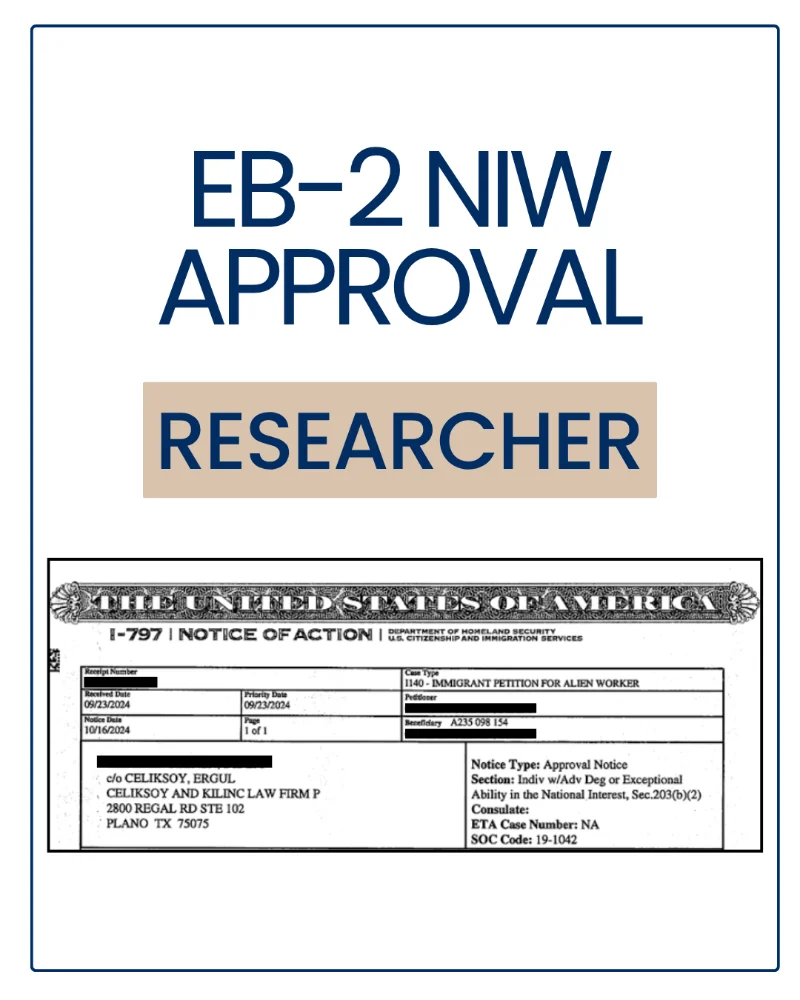
Celiksoy Law secured EB-2 National Interest Waiver approval for a pediatric dentist and professor whose research addresses inherited disorders of tooth enamel. Her petition connected a defined research plan in dental genetics with evidence of her publications, citations, research experience and work in dental education.
The case centered on amelogenesis imperfecta: a group of inherited conditions affecting enamel development. Her proposed work in the United States aimed to deepen understanding of its genetic causes, explore potential applications in diagnosis and treatment, and share research knowledge with dental professionals.
Research into inherited enamel disorders
The applicant’s research record included co-authored studies of genetic mutations associated with enamel defects. These publications investigated different aspects of enamel formation and maturation, linking clinical observations with genetic and molecular analysis.
This distinction mattered to the story of her proposed work. Her research interest concerned why inherited enamel disorders occur and how genetic differences relate to their clinical features. The petition used her related publications to establish continuity between the scientific questions she had already investigated and the research she intended to pursue in the United States.
Her wider publication record also included studies of oral health in children with systemic conditions and investigations of dental restorative materials. These provided additional context for a career connecting pediatric care with research, while inherited enamel disorders remained the central focus of the proposed endeavor.
A proposed endeavor with research and educational reach
The petition described a plan to investigate genetic mutations associated with amelogenesis imperfecta and explore how the resulting knowledge could inform diagnostic and treatment approaches. It also outlined research collaboration, publication of findings and educational activities for dental professionals.
These were proposed activities and intended applications. The case did not depend on presenting a future diagnostic tool or therapy as an already completed achievement. Instead, the petition linked the research goals to the applicant’s relevant experience and explained the potential value of sharing findings through scientific and educational channels.
Our presentation addressed the broader reach of this work: research that could contribute to understanding inherited enamel disorders, inform subsequent investigations and support professional knowledge beyond an individual clinical appointment. Her proposed endeavor was framed around these research and educational contributions rather than a single job description.
Experience supporting the proposed work
The applicant’s background combined advanced training in pediatric dentistry with further training in health professions education. Her experience included a clinical research fellowship in the United States and academic positions involving teaching, clinical supervision, curriculum development and graduate research mentoring.
The petition also documented a U.S. dental education role held at the time of filing. We used the employment and academic records to explain the substance of her professional experience. Her research preparation and educational responsibilities were relevant to different parts of the proposed endeavor: conducting scientific work and communicating its significance to students and practitioners.
Her scholarly record was supported by citation examples showing that other publications referenced her research. Editorial and peer review records, together with academic evaluation roles, provided further evidence of her participation in the scientific community. These materials supplemented the research narrative; the petition connected them to her preparation to advance the proposed work.
The evidence and its role in the petition
We organized the petition around the relationship between the proposed research and the applicant’s documented qualifications. Each evidence group served a different purpose in that presentation.
| Evidence described in the petition | Its role in the case |
|---|---|
| Academic degrees and transcripts | Supported the advanced-degree basis for EB-2 classification and explained her clinical and educational preparation. |
| Personal statement and proposed endeavor | Set out the intended U.S. research, potential applications and plans for collaboration and knowledge sharing. |
| Published research on inherited enamel disorders | Established a record of related scientific work and connected past research with the proposed endeavor. |
| Citation records and examples of citing publications | Showed that her research had been referenced in subsequent scholarly work. |
| Research, academic and U.S. employment records | Documented experience relevant to conducting research and contributing to dental education. |
| Editorial, peer review and academic evaluation records | Supported the account of her professional participation in evaluating scientific and academic work. |
| Teaching and thesis supervision records | Supported the educational component of the endeavor and her experience developing students’ research skills. |
Connecting the evidence to the NIW request
Our petition explained the potential broader significance of the proposed research, the applicant’s preparation to advance it and the reasons for requesting a waiver of the job offer and labor certification requirements. The presentation linked these arguments to her specific scientific focus and supporting record.
It also distinguished the applicant’s professional achievements from the proposed endeavor itself. Her experience explained her preparation; the research plan explained what she intended to contribute. That connection gave the case a clearer structure than a list of degrees, publications or academic titles alone.
EB-2 NIW approval
USCIS approved the applicant’s I-140 petition under the EB-2 National Interest Waiver category. Celiksoy Law represented her in obtaining this approval.
For dentists and researchers considering an EB-2 NIW petition, an assessment should consider the substance of their work, the evidence supporting it and their intended activities in the United States. To discuss your background with Celiksoy Law, contact us@celiksoylaw.com.