
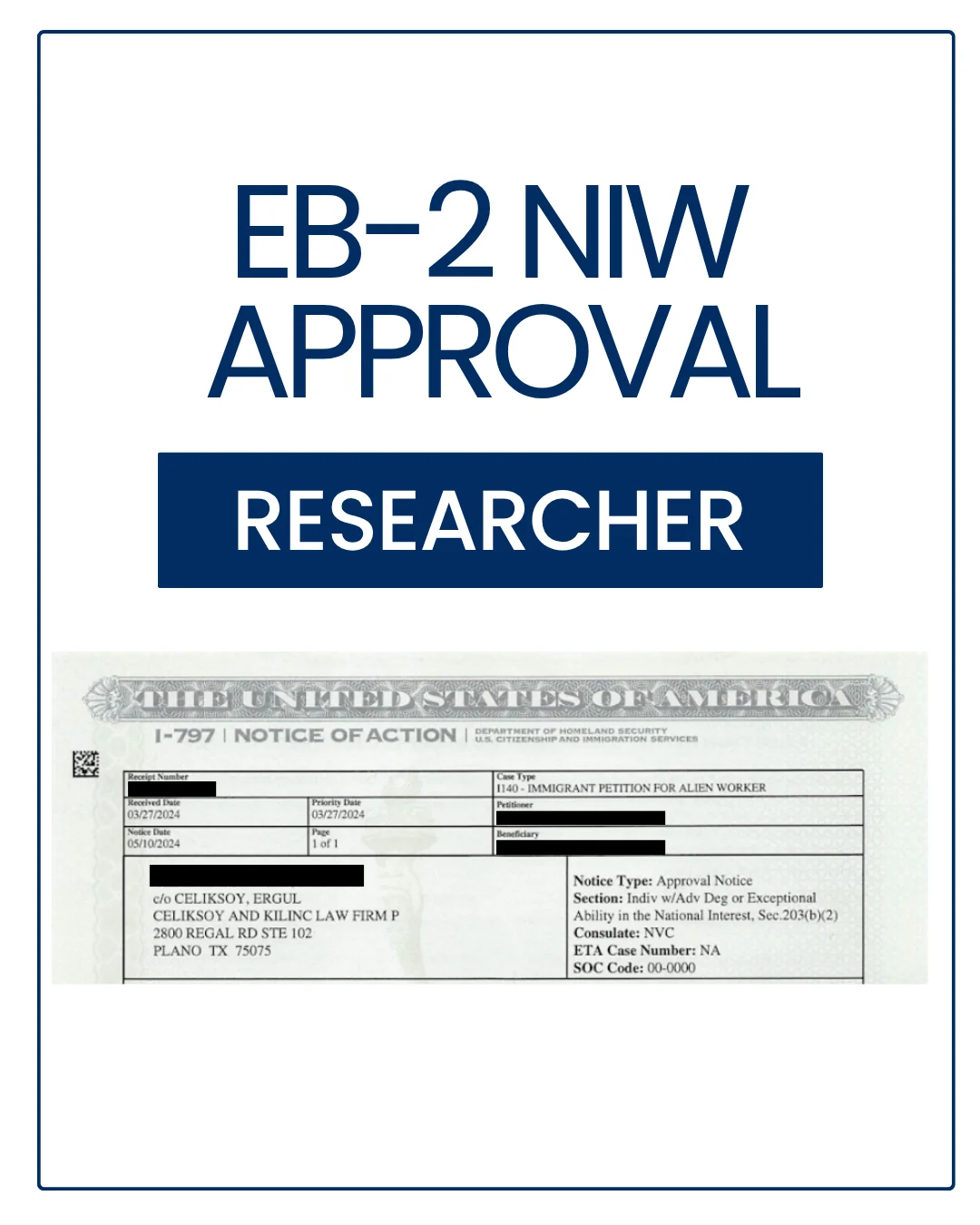
Celiksoy Law secured EB-2 National Interest Waiver approval for a prosthodontics professor whose work combines clinical dentistry, maxillofacial rehabilitation and research into the performance of prosthetic treatments. Her professional background includes investigations of facial prosthetic materials, extraoral implants, patient-reported outcomes and the biomechanics of the jaw.
Her record brings together several aspects of rehabilitation: the materials used to make a prosthesis, its interaction with surrounding tissue, and the patient’s experience of function and treatment. Alongside her research, she has taught dental students, supervised clinical training and mentored graduate research.
A career connecting clinical care and research
The applicant’s education includes a dental degree and doctoral training in maxillofacial prosthodontics. Her academic career has progressed through teaching and research roles to a professorship in prosthodontics, with experience in fixed and removable prostheses, implant-supported treatments and rehabilitation involving defects of the jaw and face.
This background provides context for her research interests. Prosthetic rehabilitation involves choices about materials, design and maintenance, as well as attention to comfort, appearance and function. Her publication record addresses these questions from different perspectives, combining laboratory investigations, clinical follow-up and studies of patients’ experiences.
Facial prosthetic materials and long-term implant performance
One area of her co-authored research examines silicone materials used in facial prostheses. The studies address how aging and processing conditions relate to color changes, including the effects of vulcanization temperature and fabrication materials. These are relevant questions for prostheses whose appearance forms part of the patient’s rehabilitation experience.
Her work also includes a long-term follow-up study of soft tissue response and the survival of extraoral implants. This extends the focus from the prosthetic material itself to the tissue and implant interface. Read together, these research areas explore how components of maxillofacial rehabilitation perform beyond the initial fitting of a prosthesis.
The studies concern different aspects of treatment and should be understood on their own terms. Their shared theme is attention to the continuing performance of prosthetic care, including appearance, biological response and the practical demands of follow-up.
Function, satisfaction and quality of life
The applicant’s research interests also include how patients experience rehabilitation. Her co-authored publications examine obturator function and satisfaction following maxillectomy, as well as the assessment of oral rehabilitation and quality of life in patients treated for head and neck cancer.
This record includes work on a Turkish-language assessment instrument and collaborative research into the concerns of head and neck cancer patients across different healthcare settings. These subjects place the patient’s perspective alongside clinical and material considerations. A prosthesis may be evaluated through more than its physical properties; function, satisfaction and the concerns patients report are also subjects of research.
Other publications address pain-related disability and quality of life in people with temporomandibular disorders. Together, these lines of work show an interest in the relationship between treatment, symptoms and daily experience, rather than a publication record limited to a single material or technique.
Biomechanics, digital techniques and dental education
Her doctoral research used three-dimensional finite element analysis to examine force distribution in the temporomandibular joint during clenching, with and without an occlusal splint. Her later publication record includes research on stress distribution in implant and abutment designs, as well as the use of rapid prototyping in auricular prosthetic rehabilitation.
The educational side of her career complements this research. Her experience includes classroom teaching, clinical supervision, curriculum work and graduate thesis mentoring. Supervised research topics include dental materials and their bonding properties. Her résumé also records editorial board service, conference contributions and book chapters relevant to dentistry and prosthetic rehabilitation.
The evidence and its role in the petition
The following elements of her documented professional record provide context for this approval story and explain the substance of her expertise.
| Documented professional record | What it shows about her background |
|---|---|
| Dental education, doctoral training and specialist qualification | Formal preparation in dentistry and prosthetic rehabilitation. |
| Co-authored studies of facial silicone materials and extraoral implants | Research addressing material appearance, processing conditions, tissue response and long-term implant performance. |
| Research on obturator function, patient satisfaction and quality of life | An interest in evaluating rehabilitation through patients’ experiences as well as clinical characteristics. |
| Doctoral and published work involving finite element analysis | Experience using computational methods to investigate jaw and implant biomechanics. |
| Teaching, clinical supervision and graduate thesis mentoring | An academic role that includes developing students’ clinical and research skills. |
| Editorial board service, conference contributions and book chapters | Professional activities extending beyond clinical practice and journal publication. |
EB-2 NIW approval
USCIS approved the applicant’s I-140 petition under the EB-2 National Interest Waiver category. Celiksoy Law represented her in obtaining this approval.
This story reflects a professional record that connects prosthetic materials, implant performance and patients’ rehabilitation needs with a sustained career in dental education. For dentists and academic researchers considering an EB-2 NIW petition, the relevant starting point is a careful assessment of their own work, available documentation and intended activities in the United States. To discuss your background with Celiksoy Law, contact us@celiksoylaw.com.