
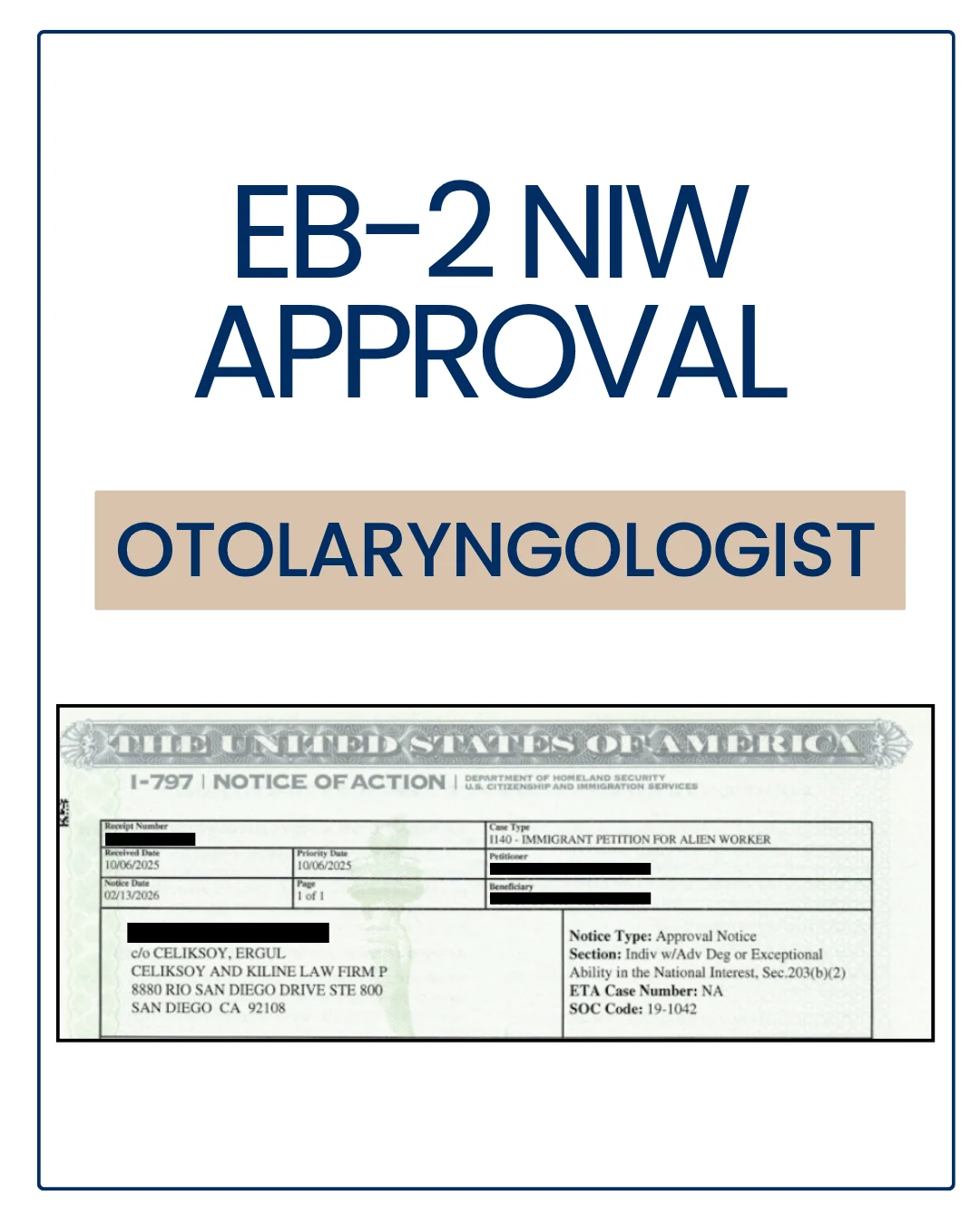
Celiksoy Law secured EB-2 National Interest Waiver approval for an otolaryngologist whose proposed research connects pediatric airway reconstruction with long-term breathing, voice, and swallowing outcomes. The petition brought together her specialist clinical background, research experience, and a defined plan for studying recovery beyond the operation itself.
The central question was how surgical treatment and rehabilitation could work together as children develop. Her proposed endeavor focused on reconstructive techniques, coordinated perioperative care, and follow-up methods that account for changing anatomy and functional needs.
Specialist experience in surgery and functional recovery
The physician completed medical education and specialist training in otorhinolaryngology in Türkiye. Her clinical career included public hospital practice and work at a teaching and research hospital, with experience in adult and pediatric ENT care, reconstructive procedures, multidisciplinary case management, and the supervision of junior physicians.
Her professional interests span facial reconstruction, laryngeal disorders, and the assessment of voice and swallowing function. This combination gave the petition a basis for explaining why she intended to study both the structural and functional consequences of airway treatment.
The supporting record also described European and Turkish specialty qualifications, international observerships, and surgical training. An observership in the United States contributed to her exposure to specialist practice and academic exchange. The petition presented these experiences alongside her clinical and scholarly work to explain her preparation for the proposed research.
A research plan built around children’s long-term outcomes
Her proposed U.S. work had three connected components. First, she planned to investigate reconstructive techniques for congenital and acquired airway problems, including laryngotracheal narrowing. The work would consider surgical planning, graft and stent selection, and postoperative management in relation to children’s growth and future functional needs.
Second, she proposed integrating surgery with structured voice and swallowing rehabilitation. The objective was to study care pathways that bring surgical treatment and functional recovery into the same plan, with attention to each child’s developmental stage.
Third, she planned to develop monitoring and follow-up approaches using endoscopic imaging, acoustic analysis, and measures adapted to growth. These methods were intended to help researchers track airway function and identify deterioration or recurrent narrowing over time.
The petition framed fewer repeat procedures, better functional recovery, and more consistent follow-up as intended benefits of the research. These were goals to investigate through future work, rather than results already achieved by a completed pediatric treatment program.
Clinical research supporting the proposed direction
Her published work includes a coauthored case report concerning an unusual cause of acute swallowing difficulty and voice disturbance associated with varicella zoster infection. The report illustrates her engagement with clinical questions involving both swallowing and laryngeal function.
She also coauthored a retrospective study of septorhinoplasty using an ethmoid bone splint in patients with caudal septal deviation and fracture. The researchers compared nasal obstruction symptoms before surgery and at follow-up, reporting improvement in the studied group. This was an adult nasal surgery study; its relevance to the petition lay in her experience evaluating functional outcomes after reconstructive treatment.
A conference research presentation examined nasal airway volume in relation to orbital complications of acute sinusitis. It added an example of work involving anatomical measurements and clinical risk assessment. Her scholarly record also included a coauthored medical book chapter addressing influenza during pregnancy, showing participation in the synthesis and communication of clinical knowledge.
Her specialist thesis investigated selected EGFR gene regions in salivary gland malignancies and reported no mutations in those regions in the samples examined. The petition used this training history to help demonstrate research experience, without treating the negative finding as proof of a new therapy.
Ongoing projects, peer review, and professional recognition
The support letter described responsibility for ongoing clinical projects involving voice and swallowing outcomes after thyroid surgery, nasal support techniques, and the relationship between intubation duration and postoperative laryngeal symptoms. These projects connected surgical interventions with functional assessment, a recurring theme in her proposed endeavor.
Completed journal peer reviews provided a separate form of scholarly activity: assessing the methods and conclusions of other researchers. Conference presentations and professional training contributed evidence of scientific exchange and continued engagement with her specialty.
The petition also described oral presentation awards, a travel grant, and professional references. The awards and grant were presented as recognition of particular activities; expert letters offered assessments of her clinical background and readiness to pursue the research plan.
The evidence and its role in the petition
| Evidence described in the petition | Its role in the case |
|---|---|
| Medical degree, transcript, and specialist qualification | Supported the advanced-degree basis for EB-2 and documented her medical training. |
| Personal statement describing the proposed endeavor | Defined the pediatric airway research, rehabilitation, and long-term monitoring activities she intended to pursue. |
| Clinical employment records and professional history | Connected the proposed work with her experience in ENT care, reconstructive procedures, and multidisciplinary practice. |
| Research publications, thesis, and medical book chapter | Illustrated experience investigating clinical questions, evaluating outcomes, and communicating medical knowledge. |
| Conference research and participation records | Documented dissemination of research and engagement with professional scientific communities. |
| Confirmation of responsibilities in ongoing research projects | Supported the account of her involvement in conducting clinical research. |
| Completed journal peer-review record | Demonstrated experience evaluating the scientific work of others. |
| Specialty qualifications, observerships, awards, and travel grant | Added context on professional development and recognition within her field. |
| Reference and independent expert opinion letters | Provided professional assessments of her background and the proposed research direction. |
Connecting the evidence to the national interest
Our petition explained the proposed endeavor’s significance through its intended reach beyond individual patient care. Research into coordinated surgical and rehabilitation pathways could produce methods and outcome measures useful to other clinical teams. That potential for broader use formed part of the argument for national importance.
We connected her clinical history, research record, ongoing projects, and professional assessments to her capacity to advance the proposed work. The request to waive the job offer and labor certification requirements was presented in relation to the benefits of that research endeavor.
USCIS approved her I-140 petition under the EB-2 National Interest Waiver category. The case illustrates how an ENT physician’s background can be organized around a specific research objective, with each type of evidence serving a distinct purpose.
If you are considering an EB-2 NIW petition as a physician or clinical researcher, Celiksoy Immigration Lawyers can review your professional background and proposed work in the United States. Contact us at us@celiksoylaw.com.