
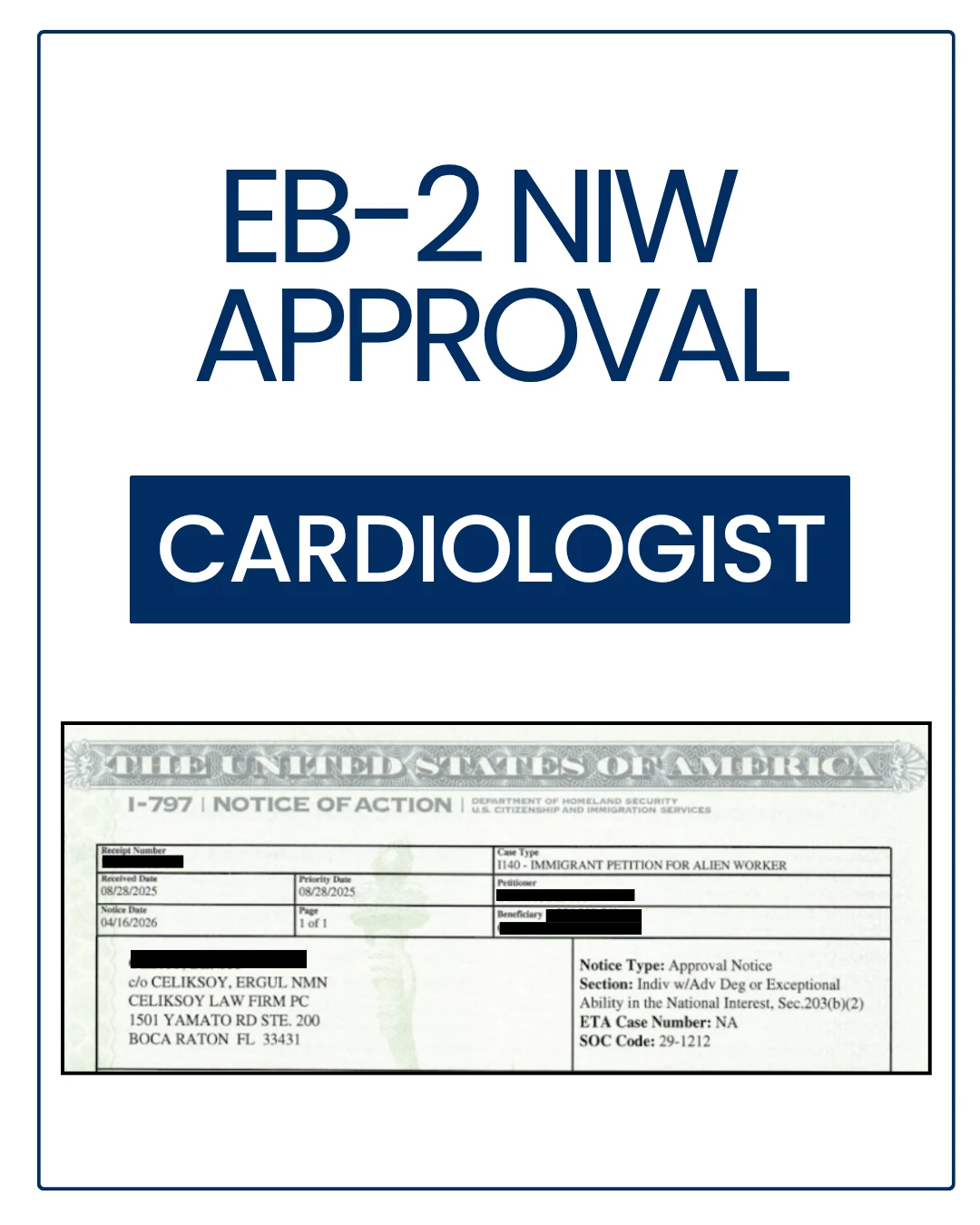
Celiksoy Law secured EB-2 National Interest Waiver approval for a cardiologist whose research connects advanced cardiac imaging with questions in cardio-oncology, heart failure and microvascular dysfunction. We developed her petition around the relationship between her clinical training, published studies, U.S. research responsibilities and proposed work.
Her American Heart Association (AHA) Postdoctoral Fellowship added a relevant form of external support. Alongside her research appointment and publications, it helped us explain both the work she intended to pursue and the preparation available to advance it.
From clinical cardiology to imaging research
The applicant completed medical school and specialist training in cardiology in Türkiye. Her professional background included hospital cardiology roles, a period of cardio-oncology training in France and subsequent postdoctoral research in the United States.
Her clinical experience supplied context for the research questions in her petition. She had worked with cardiovascular conditions before moving into research on how imaging measurements can support diagnosis and risk assessment.
The petition described a continuing U.S. research appointment in a cardiology division. Employment records and documentation of her earlier hospital roles helped connect that research work with the clinical background on which it was built.
Research on cardiac complications of cancer treatment
Her residency research examined electrical and mechanical cardiac changes in breast cancer patients receiving anthracycline chemotherapy. It considered electrocardiographic repolarization measurements together with strain echocardiography, which assesses heart muscle deformation.
We explained this study as an example of her experience investigating complementary measurements. Its relevance lay in the research question: whether electrical and imaging findings could add information when assessing treatment-related cardiac changes.
Her collaborative publications extended that interest into immune checkpoint inhibitor-associated myocarditis. These studies examined ECG findings and their relationship with clinical outcomes. A separate systematic review and meta-analysis considered cardiovascular outcomes in breast cancer survivors.
Together, these works supported a specific cardio-oncology research record. We connected them with her proposed interest in identifying and monitoring cardiovascular complications during and after cancer treatment.
Imaging markers in cardiac amyloidosis
Other studies addressed transthyretin cardiac amyloidosis. A co-authored publication investigated right ventricular strain in relation to diagnosis and risk assessment among patients with different forms of ventricular thickening.
Another collaborative study examined left atrial function and thrombotic events using multiple imaging methods. It considered how measures of atrial deformation and stiffness related to outcomes in the studied population.
These publications gave substance to the imaging component of the petition. They showed experience examining quantitative measurements alongside clinical data, supporting the proposed work on imaging biomarkers and individualized risk assessment.
Conference materials added examples of research communication on amyloidosis, cardiomyopathy and cardiac outcomes. We distinguished accepted presentations and posters from attendance records when explaining this part of her professional activity.
Research support and the heart failure direction
The support letter listed an AHA fellowship agreement, award notification and recognition certificate. We presented these materials as evidence that a cardiovascular research organization had selected her postdoctoral work for support.
The petition also described her participation in U.S. research programs supported by National Institutes of Health funding. We distinguished the funding of those programs from the fellowship awarded to her personally.
Her planned heart failure work included bedside ultrasound assessment of volume status, with particular attention to measurements involving the internal jugular vein. The intended research examined whether such measurements could improve assessment of congestion and inform questions about readmission and kidney injury. These were research aims to be evaluated.
Microvascular research and the proposed U.S. endeavor
The proposed endeavor combined cardiovascular imaging and translational research. One direction involved ultrasound-targeted microbubble cavitation, an experimental approach investigated in relation to microvascular perfusion and vascular response.
The petition described both preclinical and clinical research activity. We connected that work with her broader plan to investigate imaging-guided assessment, develop useful biomarkers and improve the information available for cardiovascular decision-making.
The plan also identified further work on imaging protocols, including possible AI integration. Existing publications and research responsibilities established the record behind the proposal; the additional methods and wider applications defined its future direction.
The evidence and its role in the petition
The supporting materials described in the petition addressed different aspects of the case: academic preparation, research experience, external support and a defined plan.
| Evidence described in the petition | Its role in the case |
|---|---|
| Medical degree, transcript and cardiology specialty records | Supported her academic qualifications and specialist training. |
| Residency thesis and related publication | Explained her early research combining ECG and echocardiographic measurements in cardio-oncology. |
| Hospital service and training certificates | Documented clinical experience and additional cardio-oncology training. |
| U.S. research reappointment letter | Supported the account of her postdoctoral role and research setting. |
| AHA fellowship agreement, notification and recognition certificate | Documented fellowship support relevant to carrying out her research. |
| Journal publications | Explained specific studies in cardio-oncology, cardiac amyloidosis and imaging-based risk assessment. |
| Research profiles and examples of citing publications | Added context about dissemination and scholarly engagement with her work. |
| Conference abstracts, acceptance and presentation records | Supported research communication and participation in scientific exchange. |
| Peer-review records | Documented experience evaluating other researchers’ manuscripts. |
| Professional membership and committee documents | Distinguished general affiliations from specific education and communication responsibilities. |
| Intended U.S. work statement | Defined the proposed imaging, heart failure and microvascular research directions. |
Connecting the record to the NIW request
Our petition explained the proposed endeavor’s merit and wider importance, her preparation to advance it and the reasons for requesting a waiver of the job offer and labor certification requirements.
The presentation connected specific research questions with supporting experience. Clinical training explained her professional foundation; studies demonstrated relevant research methods; the appointment and fellowship records added context about her capacity to continue the work.
EB-2 NIW approval
USCIS approved her EB-2 NIW I-140 petition without a Request for Evidence. The case illustrates how clinical experience, research responsibilities and external research support can be presented together when explaining a physician’s proposed endeavor.
For physicians considering an EB-2 NIW petition, the assessment should examine the work behind the publication record and its relationship with their intended activities. To discuss your background with Celiksoy Immigration Lawyers, contact us@celiksoylaw.com.