
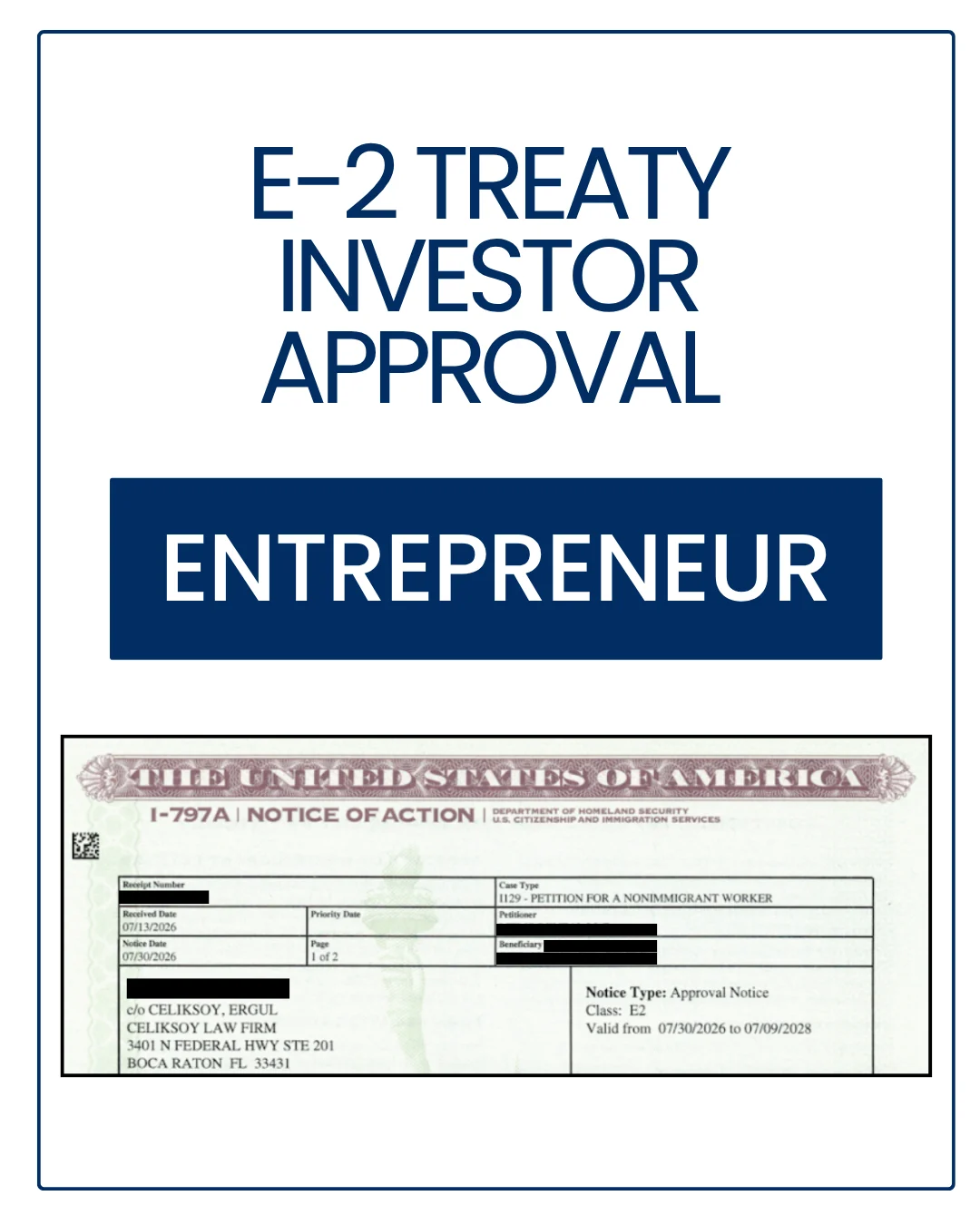
Celiksoy Law secured E-2 treaty investor status approval for an entrepreneur establishing a vehicle rental business in Illinois. Her investment was funded by a friend’s gift of vehicle-sale proceeds. The money passed through her spouse’s bank accounts before being contributed to the company on her behalf.
The petition explained that funding arrangement alongside the company’s fleet purchases, Turo reservations and management structure. Our client held a controlling ownership interest and was appointed managing member, with authority to direct the business. Her professional background was in architecture; the filing presented her proposed responsibilities in the rental enterprise through company records and a business development plan.
A rental business serving the Chicago area
The company was established to provide short-term and extended vehicle rentals in the greater Chicago area. Its business plan focused on practical passenger vehicles for residents, business travelers, visiting families and guests needing transportation for longer stays.
Turo was the company’s primary customer acquisition and booking channel. The fleet was purchased in the company’s name and listed on the platform, where customers could view specific vehicles and select rental dates. Host and listing records documented this setup, while trip screenshots showed initial reservations associated with the fleet.
The proposed model combined company-owned assets with platform-based bookings. The plan addressed vehicle preparation, pickup arrangements, maintenance, pricing and customer support as the activities needed to manage the enterprise. It gave the investment a defined commercial purpose and explained how the fleet would be used to serve customers.
Establishing the gift behind the investment
The source of capital required a clear explanation because the vehicle sold in Türkiye belonged to the donor, rather than to our client or her spouse. The donor sold his vehicle and instructed the buyer to pay the sale price directly into the spouse’s Turkish bank account.
The sale agreement documented that payment instruction. A separate donor affidavit explained that the proceeds were an irrevocable gift to our client, with no repayment expected and no ownership interest, profit entitlement or other benefit retained in connection with the gift or the company.
These documents served different functions. The vehicle records and sale agreement identified the asset and transaction generating the money. The affidavit explained why our client could use those proceeds for her investment despite the vehicle having belonged to someone else.
Our firm presented the gift documentation with the banking evidence. This connected the donor’s stated intention to the actual payment route and the contribution made to the enterprise. The funding story therefore addressed both where the money originated and the basis on which it was made available to the investor.
Following the funds through the spouse’s accounts
After the buyer paid the sale price into the spouse’s account, the funds were converted from Turkish lira into U.S. dollars. Bank statements and foreign exchange records documented the receipt and conversion. An international transfer then moved funds to the spouse’s personal account in the United States.
The U.S. bank’s wire advice recorded the incoming transfer and the subsequent payment to the company. The company’s own bank statement showed receipt of the capital contribution. Together, these records connected the vehicle sale to the business account through the intervening transactions.
The spouse’s involvement in the transfers did not replace the need to document our client’s investment and control of the enterprise. The filing explained that the contribution was made on her behalf and presented it alongside the donor affidavit and company ownership records.
This sequence made the roles of the donor, the spouse and the principal investor clear. It avoided presenting the funds as proceeds from our client’s own vehicle or leaving an unexplained gap between the buyer’s payment and the company’s capitalization.
Connecting the capital to fleet purchases
The company used a substantial portion of its capital to acquire new vehicles for the rental fleet. Dealer purchase orders identified the company as purchaser, and the business bank records documented the main payment to the dealership.
The purchase evidence also included an initial deposit, a dealer reconciliation, a loyalty incentive and a small refund. The reconciliation explained how those components were applied to the vehicle transactions and accessory purchase. It helped connect the purchase orders to the payments without treating a dealer incentive as cash supplied by the investor.
Registration records, odometer disclosures and sales tax documents added evidence of the vehicle acquisitions. Insurance materials identified the company and fleet vehicles, while photographs supported the description of the assets presented in the petition.
The filing thus followed the investment beyond receipt in a bank account. It linked the contributed capital to vehicles purchased for the business and then to the listings through which those vehicles were offered to customers.
Initial reservations and staffing arrangements
Turo records included the host profile, individual vehicle listings and trip details. Some screenshots concerned rentals already underway; others showed future reservations. This gave the petition evidence of initial customer bookings as well as the company’s public listings.
The trip records included rental periods and displayed earnings figures. They supported the account of booking activity at the time of the filing. The business plan separately described how the company intended to manage rentals, maintain the fleet and develop repeat business.
Staffing evidence went beyond a general statement that the company would hire in the future. The filing included employment eligibility and withholding forms, together with an employee information form recording a part-time arrangement, an hourly rate and scheduled hours.
These materials documented an initial staffing step. The plan also addressed further fleet support and administrative roles as operations expanded. Existing onboarding evidence and future staffing proposals were presented as distinct parts of the company’s development.
The investor’s authority to develop and direct the business
Our client was the majority owner of the company. The operating agreement and membership records documented the ownership interests, while a written member resolution appointed her managing member and gave her final decision-making authority in company matters.
This governance evidence was particularly useful in a business where the spouse also held a minority interest and participated in the funding arrangements. It identified the principal investor’s controlling position and explained her authority within the enterprise.
The business plan assigned her responsibilities for strategy, capital allocation, financial oversight, fleet acquisitions, pricing, vendor relationships and future staffing. Her résumé described experience in architectural projects, client communication and coordination with vendors and contractors. That background provided context for her profile; the company documents established her business authority.
The growth plan proposed additional vehicles, increased booking activity and further personnel. It described the use of retained earnings and possible additional capital contributions to support expansion. The petition used that plan to explain the company’s intended development alongside evidence of the assets and initial operations already in place.
The evidence and its role in the petition
| Evidence | Role in the petition |
|---|---|
| Donor’s vehicle registration and sale agreement | Identified the asset sold and documented the seller’s instruction for payment to the investor’s spouse. |
| Donor affidavit | Explained the gift to the investor and the donor’s stated absence of repayment rights or business benefits. |
| Turkish bank statements, payment receipt and foreign exchange records | Traced the buyer’s payment and its conversion into U.S. dollars. |
| International transfer confirmation and U.S. personal bank wire advice | Connected the foreign transfer to the spouse’s U.S. account and onward company contribution. |
| Company bank statements and dealership wire confirmation | Documented receipt of capital and the principal fleet acquisition payment. |
| Deposit receipt, dealer reconciliation and refund check | Explained the deposit, incentive, accessory charge and final purchase adjustment. |
| Vehicle purchase orders, odometer disclosures, tax and registration records | Documented the company’s acquisition and registration of the rental vehicles. |
| Insurance declarations, vehicle schedule, identification cards and application | Supported the insurance arrangements described for the fleet. |
| Turo profile, listings, trip screenshots and fleet photographs | Documented the listed vehicles, initial bookings and physical fleet. |
| Employee onboarding and employee information forms | Recorded the initial staffing arrangement included in the filing. |
| Operating agreement, membership records and written resolution | Established the ownership structure and the investor’s management authority. |
| Investor’s résumé and business plan | Provided professional background and described proposed management, expansion and staffing responsibilities. |
E-2 approval
USCIS approved the I-129 petition and the accompanying change to E-2 treaty investor status, enabling our client to develop and direct the enterprise in that classification.
Celiksoy Immigration Lawyers brought together the gift arrangement, banking trail, fleet acquisitions, initial reservations and governance records. The resulting presentation explained how the capital reached the company, how it was used and how the principal investor intended to lead the business.