Our client studies the forces that determine how surfaces interact at exceptionally small scales. After earning her Ph.D. in physics at the University of Twente, she pursued research appointments across Europe and the United States, followed by an assistant professorship at Clarkson University. She subsequently joined ASML as a senior materials and conditioning engineer, applying advanced surface measurements to materials challenges affecting semiconductor manufacturing equipment.
Our firm presented her proposed endeavor through the connection between precise nanoscale measurements and practical improvements in reliability. The petition included 22 peer-reviewed publications, documentation of her research and engineering roles, and studies examining adhesion, friction, and surface behavior. We explained her plans to develop reproducible measurement methods for semiconductor systems, investigate two-dimensional materials capable of exceptionally low friction, and study molecular forces at biological interfaces. Her experience supported a research agenda spanning fundamental physics and applied materials engineering.
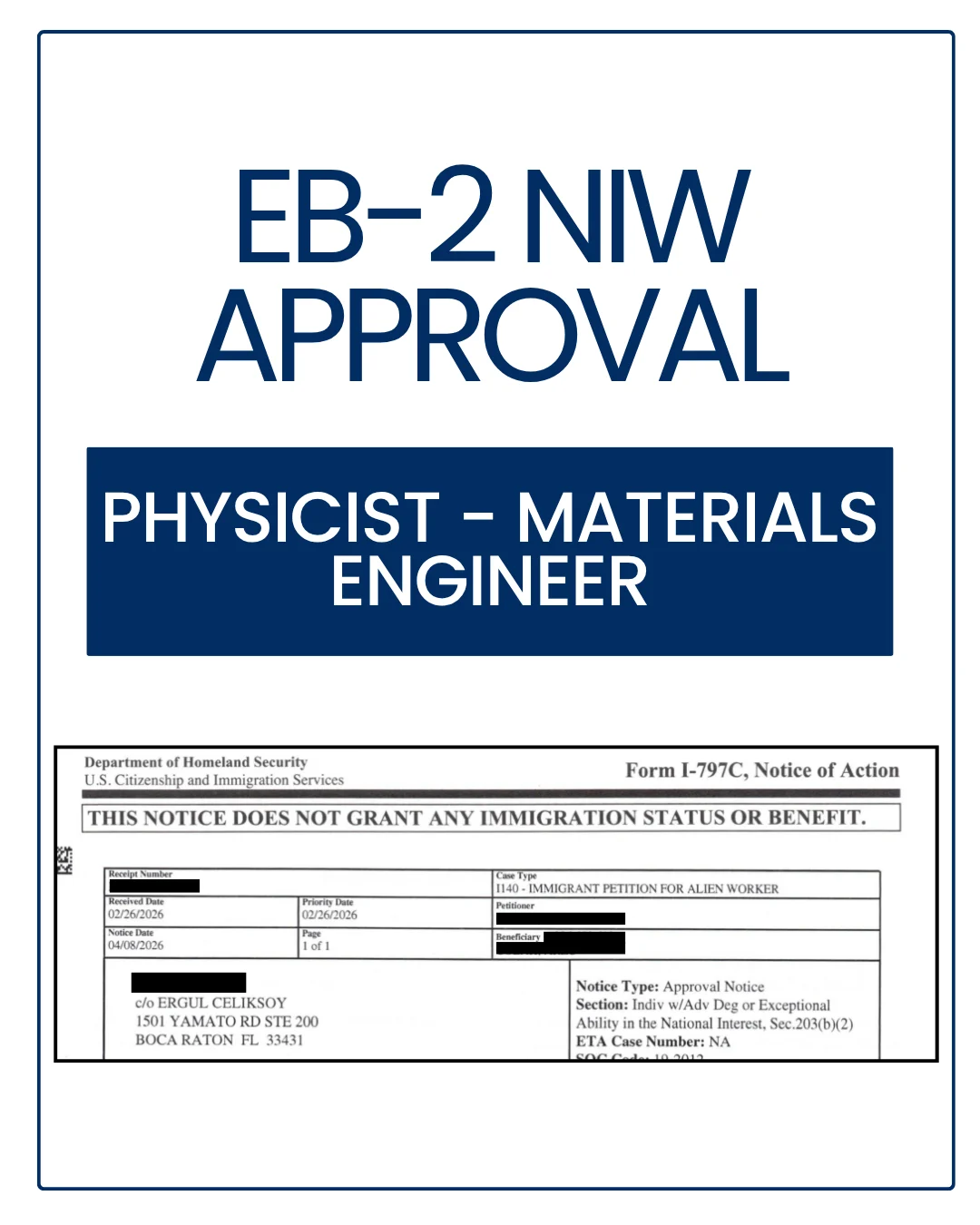
USCIS approved her I-140 petition under the EB-2 National Interest Waiver category. Her case illustrated how a specialized measurement capability can serve several distinct applications: diagnosing surface-related problems in manufacturing equipment, evaluating solid lubricants, and investigating interactions between cells and materials. Across these settings, her contribution centers on making otherwise difficult-to-observe forces measurable, providing evidence that engineers and researchers can use to improve material design and performance.