
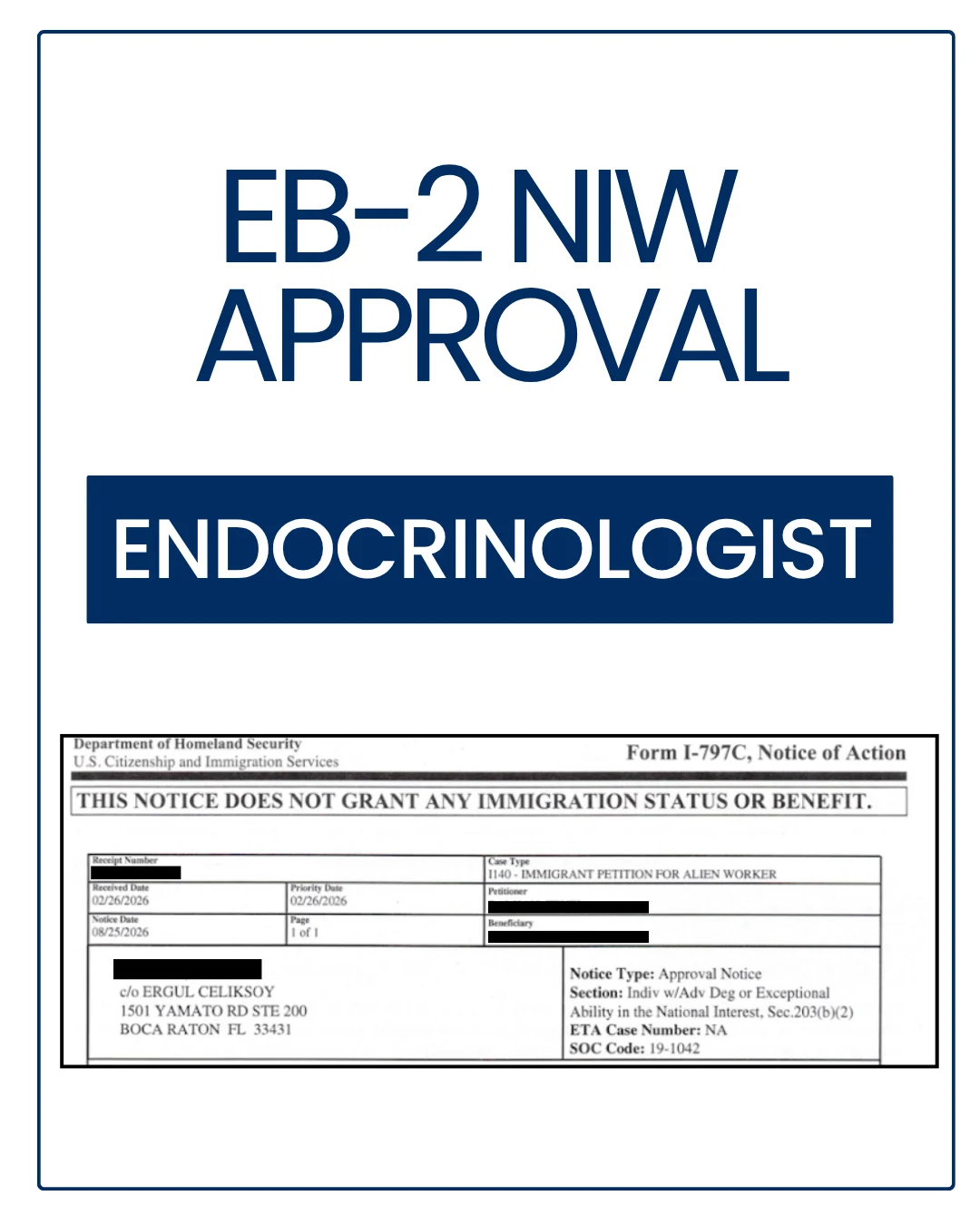
Celiksoy Law secured EB-2 National Interest Waiver approval for an endocrinologist and professor whose career combines clinical medicine, endocrine research, and medical education. His work addresses questions that arise throughout long-term care: how to assess thyroid nodules, understand diabetes-related complications, and investigate the broader effects of metabolic disease.
The professional record behind this profile includes specialist training, hospital and university appointments, peer-reviewed publications, academic evaluation, and public-facing health education. Together, these activities show how a physician’s experience can extend from individual consultations into research and the exchange of medical knowledge.
Clinical experience and an academic career
The physician trained in internal medicine before completing further specialist training in endocrinology and metabolic diseases. His clinical background includes public hospitals, private healthcare institutions, and specialist practice in Türkiye. These settings brought him into contact with a range of adult medical conditions, including diabetes, thyroid disorders, and other hormonal and metabolic problems.
Alongside patient care, he held university appointments progressing through academic ranks to professorship. His academic responsibilities included teaching and participation in institutional evaluation processes. This combination matters because it connects clinical questions with the skills needed to examine research, interpret findings, and contribute to medical education.
His profile therefore involves several distinct forms of work: treating patients, investigating clinical problems, reviewing scholarly research, and assessing academic candidates. Each contributes a different perspective on his experience in medicine.
Research on diabetes complications and thyroid assessment
One coauthored study examined vitamin D status in people with type 2 diabetes. It found lower levels among patients with nephropathy, a kidney complication of diabetes. The study offers observational evidence about a clinically relevant association; it does not establish that vitamin D supplementation prevents diabetic complications.
His thyroid research includes a coauthored retrospective study of patients who underwent surgery for Graves’ disease. The researchers examined thyroid nodules and cancer findings in that surgical population. This work contributes to discussion of malignancy assessment in Graves’ disease, while its selected patient population remains important when interpreting the results.
Another study, on which he was first author, investigated insulin resistance and thyroid cancer. It did not find a statistically significant association in the study population. That result adds useful evidence to a contested research question: investigating a possible risk factor can be valuable even when the expected relationship is not demonstrated.
He also coauthored research comparing the diagnostic performance of ultrasound-guided fine-needle aspiration biopsy across different thyroid nodule sizes. The study found that larger nodule diameter did not limit the diagnostic value of the procedure in its cohort. Its relevance lies in examining evidence used in clinical assessment and surgical decision-making.
Metabolic disease beyond conventional risk measures
The physician’s publication record also includes collaborative research on irisin and oxidative stress in gestational diabetes. By comparing women with and without the condition, the study examined biochemical features of metabolic disturbance during pregnancy. This is research into disease mechanisms and candidate markers, rather than evidence of an established diagnostic test.
In another first-author study, he and his colleagues investigated ovarian reserve measures in women with metabolic syndrome. The research reported differences in ovarian volume and hormonal measures between study groups, connecting metabolic health with reproductive endocrinology. These findings broaden the questions explored in his work beyond blood glucose and conventional cardiometabolic measures.
Across these projects, his research connects laboratory measurements with clinical observations. The record includes both first-author and coauthored publications, reflecting participation in collaborative medical research.
Academic evaluation and public health education
The supplied professional record describes completed journal reviews and service on academic juries and recruitment commissions. Journal peer review involves evaluating another researcher’s methods, analysis, and conclusions. Academic evaluation concerns a different task: assessing candidates’ scholarly work and qualifications for appointment or promotion.
The record also describes participation in a national guide concerning primary care for older patients. This adds an example of engagement with professional guidance alongside research and teaching.
His communication work extends to books for general readers and newspaper contributions addressing endocrine and metabolic health. These activities help explain another dimension of his career: presenting specialist subjects in language accessible to patients and the wider public. They are distinct from scientific publications and are best understood as health education and professional communication.
The evidence and its role in the petition
The materials supplied for this profile describe several types of evidence. Their respective functions are set out below.
| Evidence described in the supplied support letter | What it helps explain |
|---|---|
| Medical degree and specialist qualifications | The foundation of his training in internal medicine, endocrinology, and metabolic diseases. |
| Academic appointment documents and professional service records | The progression of his clinical and university career and the responsibilities associated with those roles. |
| Publications on diabetes complications and thyroid assessment | The clinical questions examined in his research and his participation as an author. |
| Studies of gestational diabetes and reproductive endocrinology | The breadth of his research into the systemic effects of metabolic disease. |
| Articles citing his research and conference records | Scholarly engagement with his work and its dissemination within the research community. |
| Journal review correspondence and academic evaluation records | His contribution to assessing research and academic candidates. |
| Professional guideline participation, books, and newspaper contributions | His engagement in professional guidance and public health communication. |
| Statement describing intended work in the United States | The research directions he proposed to pursue in endocrine and metabolic medicine. |
Research objectives and the approval
The existing case summary identifies proposed work on thyroid cancer risk assessment and diabetes complication prevention. The supplied professional materials also describe an interest in research, advanced monitoring, and digital approaches to chronic disease management. These are proposed directions for continued work; their objectives should be distinguished from outcomes already demonstrated in published studies.
USCIS approved the physician’s I-140 petition under the EB-2 National Interest Waiver category. His story brings together specialist practice, clinically focused research, academic service, and the communication of medical knowledge.
For physicians considering an EB-2 NIW petition, a useful starting point is the relationship between past work and the specific activities they intend to pursue in the United States. Celiksoy Immigration Lawyers can review that professional background and proposed work. Contact us at us@celiksoylaw.com.