
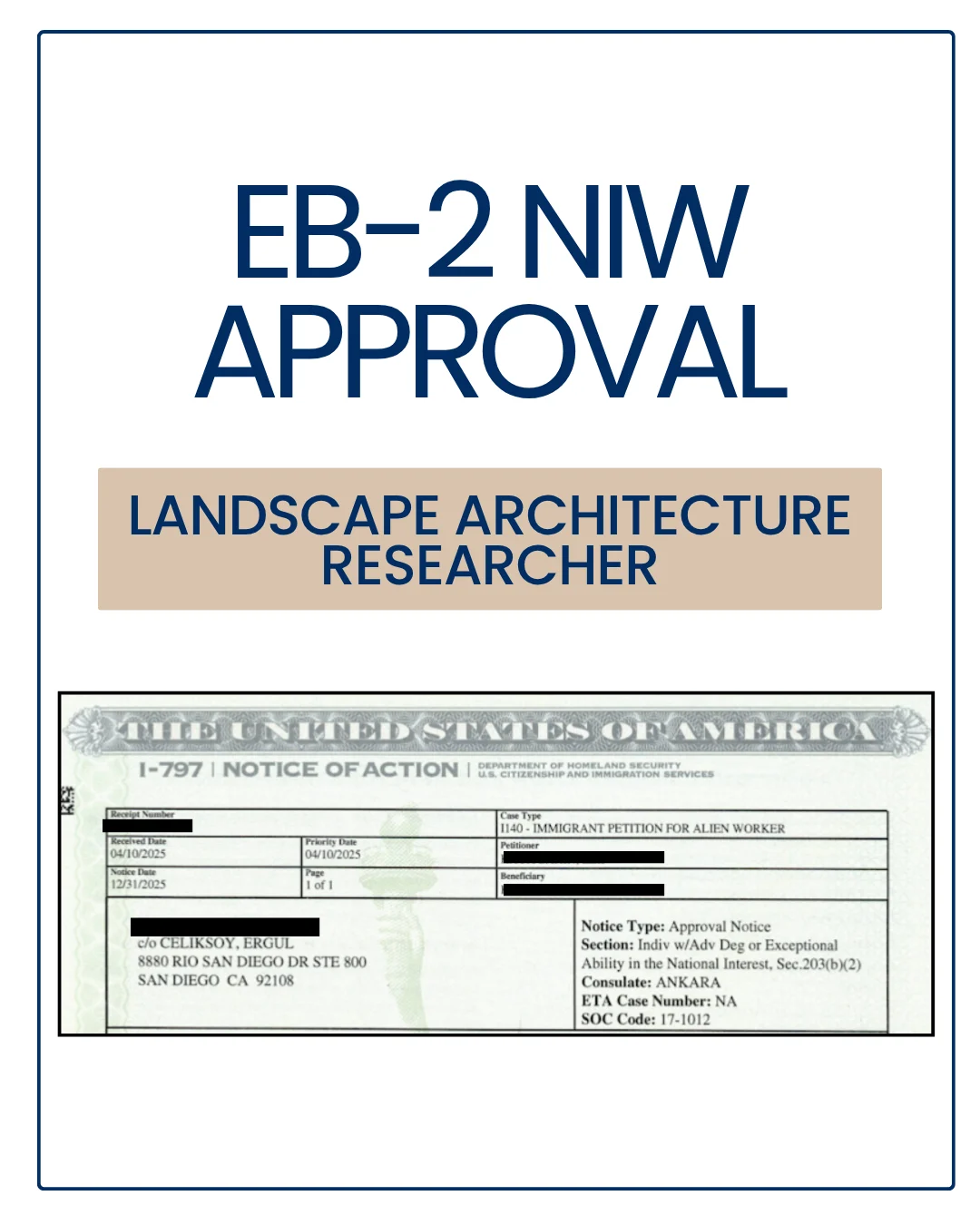
Celiksoy Law secured EB-2 National Interest Waiver approval for a landscape architecture researcher whose work connected plant propagation, spatial analysis and applied landscape design. Her petition explained how that combination supported a proposed U.S. endeavor focused on resilient green infrastructure and ecological restoration.
The preparation brought together two related questions: how to assess where planting can provide environmental value, and how to develop propagation methods for suitable plant material. We presented her completed research and professional experience as the foundation for investigating those questions further.
From plant propagation to landscape analysis
The applicant held a master’s degree and a Ph.D. in landscape architecture. Her master’s research examined tissue culture methods for a native flowering plant, using controlled laboratory conditions to investigate propagation and plant development.
Her doctoral work expanded the scale of analysis. It combined botanical field surveys, geographic information systems (GIS) mapping and survey data to examine plant diversity and the potential for flora-based tourism. This work documented experience connecting environmental information with planning decisions.
We explained how these stages complemented one another. Laboratory research supported her understanding of plant production, while fieldwork and mapping provided a basis for assessing ecological characteristics across landscapes. Together, they gave practical content to the interdisciplinary research direction described in her petition.
Academic research and applied landscape experience
The applicant’s professional history included an academic research role in landscape architecture and work with a landscaping company. Employment letters described these concurrent forms of experience.
Her academic work involved research into plant propagation, landscape analysis and biodiversity. The company role added an applied setting, including plant selection, environmental design and involvement in landscaping projects.
The petition also described participation in a funded research project on shrub propagation. Its supporting report explained work involving field assessment, plant material, propagation methods and monitoring. We used these materials to connect the proposed endeavor with relevant experience in both research and implementation.
Plant selection as a research question
A co-authored study on roadside design examined how landscape professionals assess plant selection criteria. It used structured decision-making methods to consider physical characteristics, economic factors and ecological considerations.
This was relevant to the proposed work because plant selection was a defined research problem. The study offered a way to examine competing considerations and professional judgments, supporting the account of her experience with evidence-based landscape decisions.
Other publications investigated rooting and tissue culture methods, as well as the use of different plant types in planting design. Book chapters addressed propagation techniques, local plant knowledge and public spaces. We distinguished these different contributions while explaining their relationship to her research interests.
Examples of citing publications added context about scholarly use of her work. The petition also documented scientific presentations, conference responsibilities and a book chapter review assignment.
The proposed U.S. research direction
The intended endeavor combined GIS and remote sensing with plant selection and propagation research. The plan included assessing urban heat risks, vegetation patterns and locations where green infrastructure might offer environmental benefits.
It also proposed developing propagation approaches for plants selected for their suitability to the intended setting. The planned applications included parks, green roofs, roadside landscapes and restoration areas.
Her completed work provided experience with mapping, plant research and planning. The U.S. activities were presented as the next research direction, with intended benefits relating to resource use, biodiversity and urban resilience. Potential collaboration with universities, municipalities and landscape organizations was described as part of the future plan.
The evidence and its role in the petition
The supporting materials connected her academic preparation, research methods and professional experience with the proposed endeavor.
| Evidence described in the petition | Its role in the case |
|---|---|
| Master’s and doctoral degree records | Supported the academic foundation of the petition and her training in landscape architecture. |
| Thesis materials | Explained experience in plant tissue culture, botanical fieldwork and GIS-based landscape analysis. |
| Academic and industry employment letters | Documented research roles and practical involvement in landscaping projects. |
| Intended U.S. work statement | Defined the proposed activities in green infrastructure, plant propagation and ecological restoration. |
| Shrub propagation project completion report | Supported the account of her participation in funded plant research. |
| Journal articles and book chapters | Documented research and scholarly contributions to plant selection, propagation and landscape planning. |
| Research profile and examples of citing publications | Added context about dissemination and engagement with her work. |
| Conference records and book chapter review certificate | Supported scientific communication, event responsibilities and scholarly evaluation. |
| GIS, environmental analysis and design training records | Added detail about technical preparation relevant to the proposed research. |
Connecting the record to the NIW request
Our petition addressed the endeavor’s merit and wider importance, the applicant’s preparation to advance it and the reasons for requesting a waiver of the job offer and labor certification requirements.
The explanation linked specific research activities with potential uses in urban greening and restoration. Environmental planning materials supplied background, while her own thesis work, publications and employment documentation supported the account of relevant experience.
The case therefore connected laboratory methods, spatial analysis and applied landscape work through a defined research plan. Each evidence group contributed a distinct part of that presentation.
EB-2 NIW approval
USCIS approved the applicant’s EB-2 NIW I-140 petition. Her case illustrates how research across plant science and landscape planning can be presented together when explaining a proposed environmental contribution.
For researchers considering an EB-2 NIW petition, the assessment should examine their own work, intended activities and supporting evidence. To discuss your background with Celiksoy Immigration Lawyers, contact us@celiksoylaw.com.