
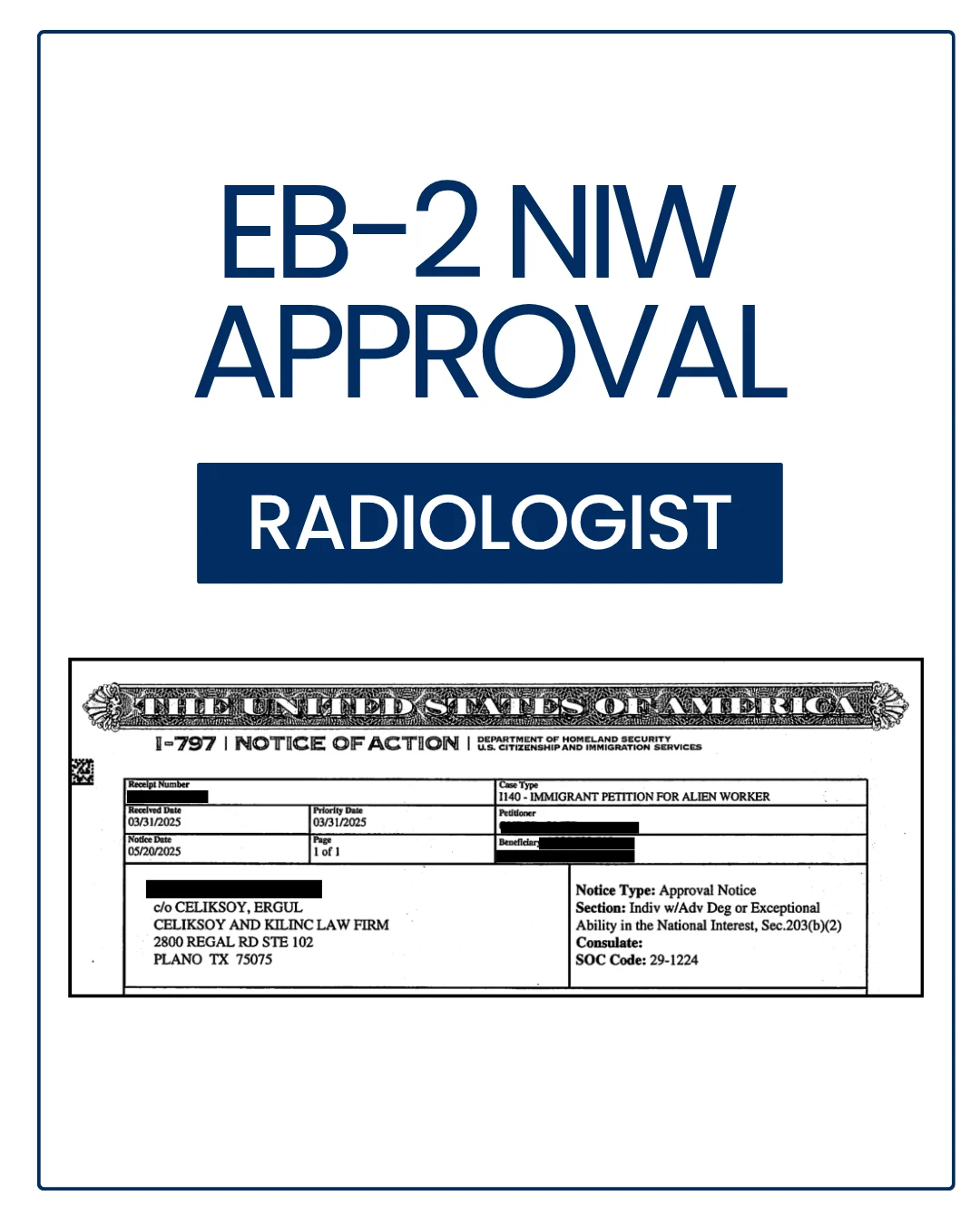
Celiksoy Law secured EB-2 National Interest Waiver approval for a radiologist whose work connected advanced medical imaging with clinical decision-making. His petition brought together cardiothoracic fellowship training, a U.S. academic appointment and research on prostate MRI, diagnostic errors and complex imaging findings.
The proposed endeavor focused on refining imaging protocols and investigating AI-assisted approaches to diagnosis. We explained how his clinical and research experience supported that direction, using the specific studies, professional responsibilities and scientific contributions described in his record.
Specialized training and academic experience
The applicant completed medical school and radiology residency before undertaking a cardiothoracic imaging fellowship in the United States. His professional history also included radiology practice, a clinical instructor role and an assistant professor appointment.
The petition documented these stages through medical and specialty education records, a fellowship completion certificate, service records and appointment documentation. Each contributed a different part of the professional account: foundational qualifications, specialized imaging preparation and experience within academic medicine.
His cardiothoracic background supported the proposed focus on heart and lung conditions. The academic appointment provided practical context for combining imaging work, research and medical education in the United States.
Prostate MRI and risk assessment
An important research strand concerned multiparametric prostate MRI and its relationship to the risk of clinically significant prostate cancer. The applicant’s residency thesis examined diagnostic performance and follow-up outcomes. His subsequent co-authored research investigated how imaging categories and clinical information could inform risk assessment.
The petition also described his participation in an international collaborative project on prostate cancer imaging and artificial intelligence. His contributions included research presentations and a peer-reviewed study on long-term follow-up and the prognostic value of MRI findings.
These materials gave substance to the proposed work. They showed experience relating images to clinical questions, including the assessment of cancer risk and the information needed when considering further investigation.
Conference work on machine learning and external validation of a prostate segmentation model added another dimension. We presented these as specific research activities, distinguishing predictive modeling and validation from a claim that the applicant had already deployed a broadly adopted clinical AI system.
Heart, lung and diagnostic interpretation research
The applicant’s cardiothoracic work addressed imaging of vascular anatomy, cardiac conditions and lung disease. His scientific presentations included case-based examination of myocardial changes, lung cancer imaging and radiological assessment associated with minimally invasive cardiac surgery.
His publications also addressed interpretation errors and cognitive bias in radiology. This work was relevant to the case’s wider emphasis on diagnostic accuracy: imaging quality and new technology matter alongside the way findings are interpreted and communicated.
The proposed endeavor sought to build on that background through advanced CT and MRI protocols, research into complex pulmonary conditions and AI-assisted diagnostic approaches. Earlier recognition, more precise assessment and fewer unnecessary procedures were intended benefits of the proposed work.
Scientific communication and recognition
Conference materials documented his contribution to scientific and educational presentations. The petition included awards for particular exhibits, including work on cardiac and lung imaging, as well as recognition for educational material on diagnostic errors.
These records supported the account of scientific communication and recognition for specific work. Published articles, examples of citing studies and completed journal review assignments added context about his engagement with the radiology literature.
We considered these activities alongside the research itself. The presentation explained what he had studied and communicated, how that experience related to the proposed endeavor and which documents supported the account.
The evidence and its role in the petition
The supporting materials connected his professional preparation with the research he intended to advance.
| Evidence described in the petition | Its role in the case |
|---|---|
| Medical degree and radiology specialty records | Supported the academic foundation and professional training described in the petition. |
| Cardiothoracic fellowship completion certificate | Documented specialized preparation in heart and lung imaging. |
| Appointment letters and employment records | Explained his academic roles and clinical professional history. |
| Proposed endeavor statement | Defined the intended work in imaging protocols, diagnostic research and AI-assisted approaches. |
| Thesis materials and co-authored publications | Supported his research experience in diagnostic performance, follow-up and imaging interpretation. |
| Collaborative project materials and conference presentations | Explained participation in prostate imaging research and scientific communication. |
| Awards and exhibit recognition records | Documented recognition for particular scientific and educational contributions. |
| Research profiles and examples of citing publications | Added context about the dissemination and scholarly use of his work. |
| Completed journal review records | Supported his experience evaluating other researchers’ manuscripts. |
| Examination, certification and medical license documents | Documented separate aspects of his professional qualification and preparation. |
Presenting the NIW request
Our petition addressed the proposed endeavor’s merit and wider importance, the applicant’s preparation to advance it and the reasons for requesting a waiver of the job offer and labor certification requirements.
The explanation connected the proposed activities with potential uses in disease assessment, imaging interpretation and clinical research. His training and academic record supported preparation; the published studies and project contributions illustrated relevant experience; and the work plan described the intended direction of further contributions.
This allowed us to present a coherent account of an academic radiologist’s work, with specific evidence behind the research subjects and professional roles.
EB-2 NIW approval
USCIS approved the applicant’s EB-2 NIW I-140 petition. His case illustrates how clinical expertise, specialized training and research contributions can be connected within a defined imaging research endeavor.
For physicians considering an EB-2 NIW petition, the assessment should examine their own professional record, intended work and supporting evidence. To discuss your background with Celiksoy Immigration Lawyers, contact us@celiksoylaw.com.