
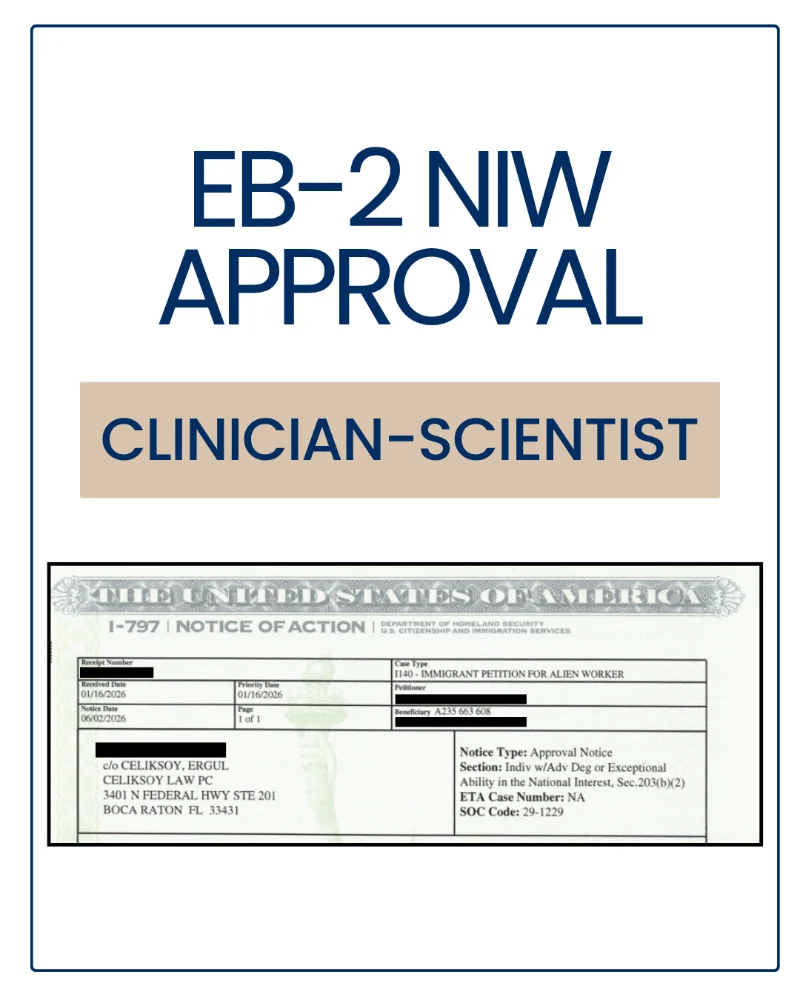
Celiksoy Law secured EB-2 National Interest Waiver approval for a clinician-scientist whose work connects immunology with kidney organoid research. His background combines medical education and pediatric specialty training with doctoral and postdoctoral research into immune regulation and regenerative medicine.
His scientific interests address related questions: how immune responses are controlled, how engineered kidney tissue can be developed as a research platform, and how the immune system interacts with that tissue. Together, these areas provide the context for his work on kidney disease and transplantation research.
From clinical training to experimental immunology
The applicant began with medical education and pediatric training before developing a research career in immunology. His doctoral work investigated mechanisms through which regulatory T cells influence immune responses, including interactions involving immune checkpoint proteins.
His co-authored publications include research on regulatory T-cell mechanisms, immune regulation and tumor immunology. This record reflects an interest in the cellular and molecular processes that shape immune activity. It also provides a foundation for his later work examining how immune responses affect engineered tissue.
The connection between these fields lies in their scientific questions. Understanding immune regulation is relevant to investigating both immune-mediated injury and the response to transplanted tissue. His professional background brings clinical preparation and experimental research together in approaching those questions.
Kidney organoids as research models
Kidney organoids are laboratory-grown models containing kidney-like tissue derived from stem cells. They offer platforms for investigating aspects of kidney development and disease, while researchers continue to work on their maturity, structure and function.
The applicant’s publication record includes a co-authored review of kidney organoid research, discussing disease modeling and emerging technologies for studying kidney tissue. This is a scholarly review of developments in the field, complementing his experimental research experience.
His research background also includes work on improving organoid maturation and vascularization: the development of blood vessel networks associated with engineered tissue. These topics concern the quality and usefulness of laboratory models and their potential role in future regenerative medicine research.
Investigating immune responses to engineered tissue
Another strand of his work examines immune responses to human kidney tissue assembled from organoid components. The research interests described in his professional record include studying immune rejection and exploring approaches to limit immune-mediated injury.
This work links organoid development with immunology. Improving an experimental tissue model and understanding its interaction with immune cells are complementary research challenges. The aim is to develop platforms through which researchers can investigate biological mechanisms and evaluate potential approaches to treatment.
The scientific record also includes co-authored research into signaling involved in renal vitamin D activation and calcium regulation. Alongside his immunology background, this provides further context for his involvement in kidney-related biomedical research.
The evidence and its role in the petition
The professional materials reviewed for this story describe several elements of his research background. Their relevance is outlined below.
| Professional material reviewed | What it establishes about his background |
|---|---|
| Medical, pediatric training and doctoral records | The clinical and scientific education underlying his interdisciplinary career. |
| Immunology publications and doctoral research | Experience investigating regulatory T cells and mechanisms controlling immune responses. |
| Kidney organoid review and research descriptions | Engagement with disease modeling, engineered kidney tissue and regenerative medicine research. |
| Research employment records described in the supporting letter | Academic research experience, including postdoctoral work in the United States. |
| Citation examples and conference materials | Scholarly references to his research and communication of scientific work. |
| Expert assessments quoted in the supporting letter | Professional perspectives on his research contribution, technical abilities and collaborative work. |
Continuing an interdisciplinary research career
The research direction described in the available materials brings together organoid development, immune responses and kidney disease models. The intended work includes improving experimental platforms and investigating immune mechanisms relevant to injury and rejection.
These interests extend a scientific career across immunology and regenerative medicine. They also explain why the applicant’s background is best understood through the relationship between his clinical training, molecular research and work on engineered tissue.
EB-2 NIW approval
USCIS approved the applicant’s I-140 petition under the EB-2 National Interest Waiver category. Celiksoy Law represented him in obtaining this approval.
For clinicians and biomedical researchers considering an EB-2 NIW petition, an assessment should examine their research, available documentation and proposed U.S. activities together. To discuss your background with Celiksoy Law, contact us@celiksoylaw.com.