
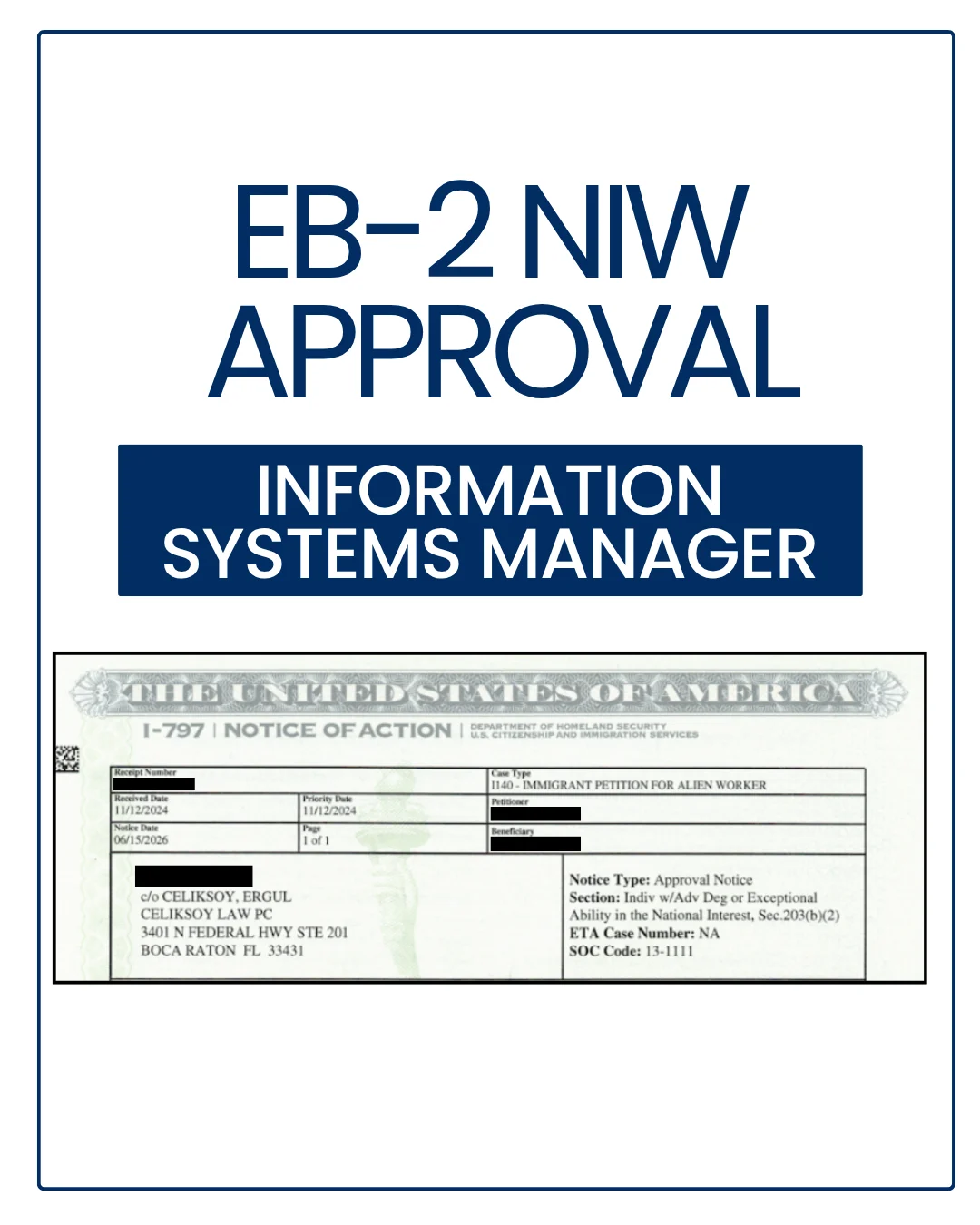
Celiksoy Law secured EB-2 National Interest Waiver approval for an information systems manager and engineer whose background combined operational leadership with research in artificial intelligence and computer vision. His petition centered on a plan to establish a U.S. consultancy and technology development business offering AI-based asset management solutions to small and medium-sized enterprises.
The case connected three elements: experience managing complex institutional systems, a research record in machine learning, and a business plan explaining how he intended to apply those capabilities to clients’ operational needs.
From systems management to a U.S. consultancy plan
The applicant’s professional experience covered inventory planning, maintenance management, software development, systems analysis and business intelligence. His responsibilities included evaluating requirements, working with logistics data, managing development projects and supporting decisions about materials and resources.
These activities provided a practical foundation for the proposed business. Inventory and maintenance systems depend on the relationship between operational processes, reliable data and usable software. The petition explained how his experience across those areas related to the services he planned to offer in the United States.
His consultancy would focus on asset management involving materials and software. The proposed services included business process analysis, systems integration, data management, software development and enterprise resource planning implementation. Small and medium-sized businesses were the intended client group, particularly those needing specialist support to develop their information systems capabilities.
The research behind his AI expertise
The applicant held graduate qualifications in computer science and electronics and communications engineering. His doctoral research addressed visual recognition and machine learning, including methods for representing data and learning relationships between visual categories and attributes.
His publication record included work on scene classification, data clustering, neural network architectures and unsupervised feature learning. These subjects explain the substance of his technical background: extracting useful information from complex data, representing it for analysis and developing methods of classification or grouping.
We presented this research alongside his operational experience. The publications documented research capability in relevant computational methods, while the employment evidence documented experience with organizational systems and development projects. The business plan described how he intended to combine these capabilities in the proposed consultancy.
Asset management services for smaller businesses
The proposed endeavor sought to help U.S. businesses improve how they manage operational assets and use information to make decisions. The plan brought together AI-based applications with process analysis, software development and integration of existing systems.
For example, the applicant’s experience in stock planning, critical materials analysis and maintenance systems was relevant to understanding the information a business needs when allocating resources. His business intelligence and data analysis background complemented the software and systems work involved in organizing that information.
These connections formed part of our presentation of the proposed services. Their intended benefits included more effective resource allocation and improved operational efficiency. The petition also discussed business growth and planned recruitment as potential economic contributions. These were goals and projections in the business plan, rather than completed commercial results.
Research experience and professional preparation
The supporting record included U.S. research experience, research grant documentation and invitations for research placements. These materials added context to his academic preparation and his engagement with machine learning and computer vision research.
Technical training records covered programming, databases, deep learning, data engineering and systems and project management. Citation examples showed that other publications had referenced his research, and conference materials supported the account of his participation in scientific exchange.
We used these evidence groups to explain different parts of his preparation. His qualifications and research supported his technical background; his professional record supported his experience delivering and managing systems; and the business plan set out the intended application of that combined expertise.
The evidence and its role in the petition
The petition linked the proposed consultancy to a documented record of relevant education, research and practical work.
| Evidence described in the petition | Its role in the case |
|---|---|
| Academic degrees, transcripts and thesis materials | Supported the advanced-degree basis for EB-2 classification and explained his engineering and computational research preparation. |
| Employer documentation and professional history | Documented responsibilities involving information systems, inventory planning, development projects and business intelligence. |
| Detailed business plan | Defined the proposed services, intended clients, operating approach and growth projections. |
| Published research on machine learning and visual data | Provided evidence of technical research capability relevant to the AI component of the proposed work. |
| Citation examples and conference materials | Showed scholarly references to his work and participation in research dissemination. |
| Research grant records and U.S. research invitations | Supported the account of funding and opportunities for further scientific work. |
| Technical training certificates | Supplemented the record with training in programming, data, deep learning and systems management. |
Presenting the NIW request
Our petition addressed the proposed endeavor’s potential broader economic and technological value, the applicant’s preparation to advance it and the reasons for requesting a waiver of the job offer and labor certification requirements. The presentation connected these arguments to the planned consultancy and its intended services for U.S. businesses.
The relationship between his prior work and future plan was central to the case. His background explained the capabilities he brought to the endeavor; the business plan explained the activities through which he intended to apply them.
EB-2 NIW approval
USCIS approved the applicant’s I-140 petition under the EB-2 National Interest Waiver category. Celiksoy Law represented him in obtaining this approval.
For information systems professionals, engineers and researchers considering an EB-2 NIW petition, an assessment should examine their specific work, supporting evidence and proposed U.S. activities. To discuss your background with Celiksoy Law, contact us@celiksoylaw.com.