
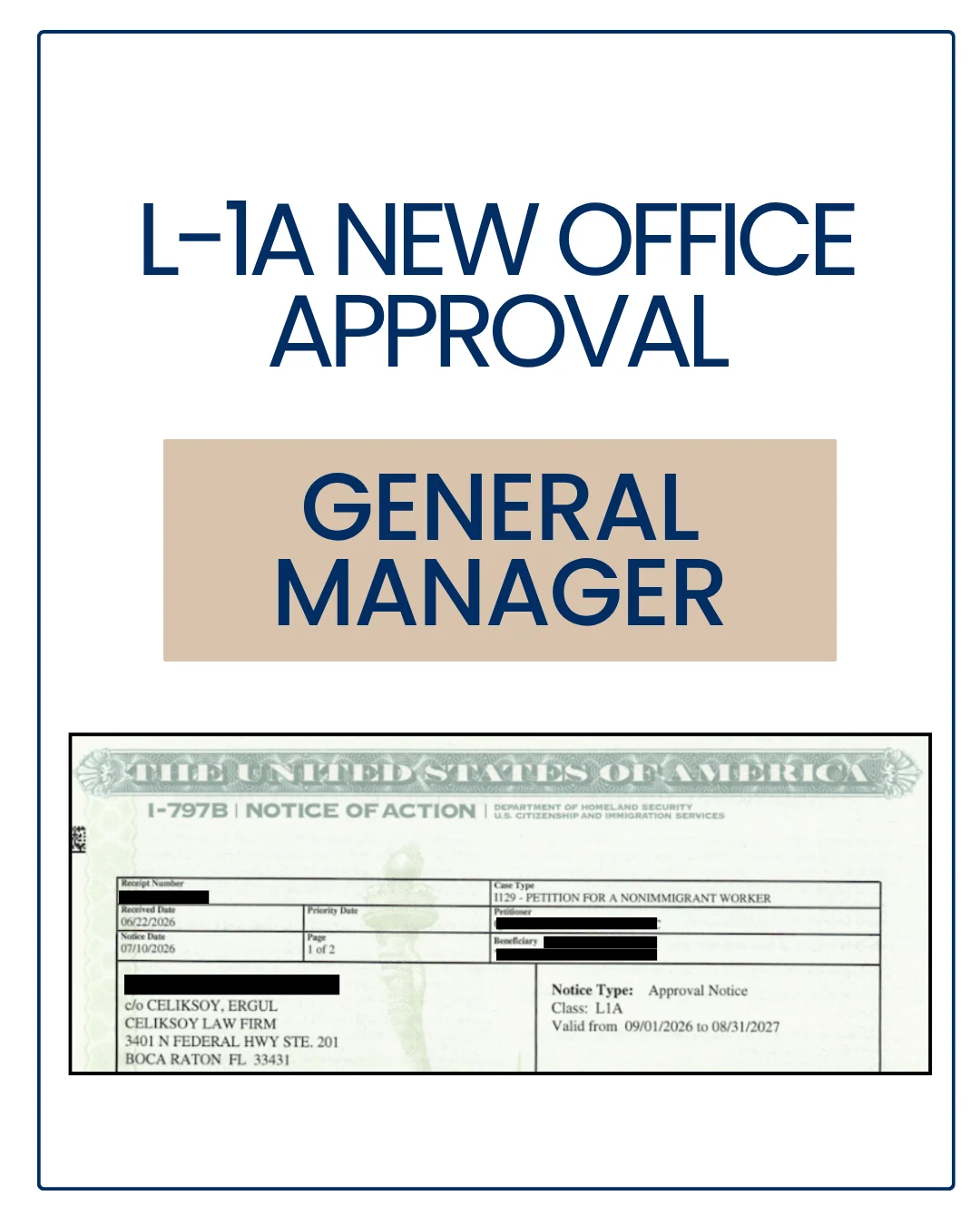
Celiksoy Law secured L-1A new office petition approval for a general manager of a Turkish apparel business planning an affiliated operation in New York. The proposed transfer would place him in charge of the U.S. company’s market entry, brand development, e-commerce strategy and operational growth.
The case involved a business that had changed its legal structure in Türkiye and a U.S. company at the establishment stage. Our firm connected the manager’s employment history to the continuing foreign business, documented ownership and control across the two companies, and presented the proposed organization of the new U.S. office.
Bringing an apparel brand to the U.S. market
The foreign business developed and sold contemporary apparel through a model combining collection planning, supplier coordination, digital marketing and online sales. Its records included customer orders, supplier invoices, bank activity, tax materials and brand documentation.
The U.S. company was established to develop the brand’s American presence. The business plan described online apparel sales, customer acquisition, marketing, fulfillment coordination and cooperation with the Turkish operation on products and sourcing.
This was a planned expansion of an existing commercial business. The foreign company’s trading records supplied evidence of its operations, while the U.S. formation documents, office arrangements and capitalization records showed the steps taken to establish the American entity. The petition presented those two stages separately and explained how they were intended to work together.
Employment continuity through a change in business structure
Our client’s employment began while the apparel business operated as a sole proprietorship. He initially served as creative director and later became general manager. The business subsequently continued under a limited company structure.
The filing explained this history rather than presenting the limited company’s formation date as the beginning of all business activity. The foreign employer’s letter described the earlier operation, the incorporation and the continuation of our client’s duties. Employment agreements, compensation records and commercial materials supplied supporting context.
His earlier responsibilities included creative direction, product development and brand coordination. As general manager, his role extended across departments, personnel, suppliers and business planning. The résumé and employment documentation described that progression; records of management decisions added examples of the work associated with it.
Our firm used the chronology to connect the employment history with the organization requesting the transfer. The petition distinguished the business’s legal structure from its operational history and explained how the managerial assignment continued through the transition.
Ownership and control across the two companies
The manager held ownership interests in both the Turkish business and the U.S. company. Those interests differed in size, so the filing addressed his authority as well as the ownership percentages.
U.S. formation documents, the operating agreement and membership records established the American company’s structure. Foreign corporate records and the relationship statement explained the Turkish ownership arrangement. Management and expansion resolutions added evidence of the authority exercised within the business and the decision to establish a U.S. operation.
The companies’ proposed coordination covered product development, sourcing, branding and operational planning. The petition presented that commercial relationship alongside the corporate evidence supporting its affiliate argument.
This combination was important to the case presentation: a shared brand described the business connection, while ownership and control documents addressed the relationship between the legal entities. Our firm explained both without treating the companies as a parent and wholly owned subsidiary.
Evidence of management beyond the job title
The foreign organizational records described a team working across product development, graphic design, logistics and operations. Job descriptions explained who performed the underlying tasks and how responsibilities were assigned within the company.
The petition also included employee contracts, payroll materials, staff résumés and educational records. These helped give substance to the organizational chart and the roles shown beneath the general manager.
Other documents illustrated his involvement in management decisions. Performance evaluation materials addressed personnel assessment; hiring correspondence and employment contracts addressed staffing authority. Commercial agreements, payment-related records and internal meeting minutes added examples of supplier, financial and strategic coordination.
One set of meeting records concerned marketing performance, including the review of website and advertising data. Another addressed the proposed U.S. expansion, fulfillment alternatives and the allocation of management responsibility. These examples connected the stated duties to decisions about people, resources and business development.
The petition’s managerial argument therefore relied on more than a title or a broad duty list. It used the reporting structure and operational records to explain how our client directed functions, reviewed performance and coordinated execution by employees and service providers.
Establishing the New York office
The American entity had been formed and had opened a business bank account. Transfer documentation identified funding sent by the foreign company, and U.S. banking records supported the capitalization presentation.
The office evidence included a workspace agreement, photographs and paid invoices for the office arrangement and deposit. These documents supported the account of physical premises secured for the new operation.
The filing paired that setup evidence with a business plan describing the intended launch. The plan addressed e-commerce infrastructure, customer acquisition, product coordination and the use of external providers for operational support.
The foreign business was expected to continue operating in Türkiye while the U.S. company developed. Its existing brand, supplier relationships and product experience formed part of the proposed support for the expansion. The petition described the U.S. office as a new operation with an implementation plan, rather than an already mature American business.
A U.S. role built around direction and delegation
The proposed general manager role covered market entry, product and sourcing oversight, vendor relationships, marketing direction, budgeting and organizational development. The job description also addressed limited involvement in startup coordination.
A central part of the presentation was explaining how routine execution would be handled. The business plan proposed external fulfillment, logistics, marketing and technical support, together with future employees as the company developed. It distinguished the general manager’s direction of those functions from the underlying work of processing orders, preparing shipments and providing operational support.
The staffing presentation described further marketing, logistics and administrative capacity during the company’s development. The financial plan anticipated startup losses and continuing support from the foreign business, alongside projected sales growth.
Our firm presented these materials as plans for the new office. They explained the proposed path toward an organization supporting a primarily managerial position and connected the intended U.S. assignment to our client’s documented management background abroad.
The evidence and its role in the petition
| Evidence | Role in the petition |
|---|---|
| Foreign employer’s letter, employment agreements and résumé | Explained the employment chronology, progression from creative director to general manager and business-structure transition. |
| Compensation and bank payment records | Supported the account of remuneration associated with the foreign assignment. |
| Foreign corporate and ownership records | Documented the Turkish entity’s structure and ownership interests. |
| U.S. formation documents, operating agreement and membership certificate | Established the American company’s legal structure and ownership. |
| Relationship statement and expansion decision records | Explained the affiliate argument and authorization of the proposed U.S. operation. |
| Foreign tax materials, bank statements, orders and supplier invoices | Supplied evidence of commercial activity in the foreign business. |
| Trademark and promotional materials | Supported the description of the brand and products involved in the expansion. |
| Foreign organizational chart, job descriptions and staff records | Explained reporting lines, employee roles and the allocation of operational work. |
| Performance assessments, employment contracts and hiring correspondence | Illustrated the manager’s involvement in personnel decisions and supervision. |
| Commercial agreements and internal meeting records | Provided examples of vendor coordination, strategic review and expansion planning. |
| U.S. funding records, workspace agreement, photographs and paid office invoices | Documented capitalization and the new office’s establishment arrangements. |
| Proposed U.S. job description, organizational plans and business plan | Described the managerial assignment, delegation model, future staffing and planned development of the office. |
L-1A petition approval
USCIS approved the I-129 petition for L-1A classification. The approval supported the planned transfer of our client to lead the new U.S. operation as general manager.
Celiksoy Immigration Lawyers presented the foreign employment history, corporate relationship and new office plans as a connected case. The filing explained the business behind the expansion, the manager’s authority abroad and the organization proposed for his American assignment.